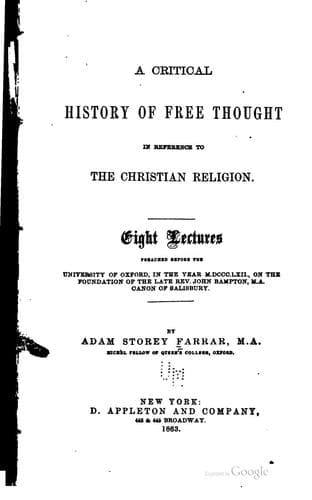
History of Free Thought in Reference to The Christian ReligionFarrar, Adam Storey
History
History of Free Thought in Reference to The Christian Religion
Farrar, Adam Storey
Free thought -- History
The same principles of criticism mislead him in his examination of
Christianity. The hallowed doctrine of the atonement forms a
stumblingblock to him, on the ground of the transfer of merit by
imputation.(457) He regards Christianity as a Jewish gospel, until it was
altered by the apostles, whose authority he discredits by arguments not
unlike the ancient ones of Celsus. The method of Morgan is more
constructive than that of his predecessors. Not denying the historic
element of Christianity by idealizing it as Collins, he attempts a natural
explanation of the historic facts. The central thought which guides him
throughout is the supreme authority of the moral reason. His works open up
the broad question whether the moral sense is to pronounce on revelation
or to submit to it, and thus form a fresh illustration of the intimate
dependence of particular sceptical opinions and methods upon metaphysical
and ethical theories.
In the period which we are now examining, deism was almost entirely
confined to the upper classes. It was in the latter part of the century
that it spread to the lower, political antipathy against the church giving
point to religious unbelief. Chubb,(458) whom we next consider, is one of
the few exceptions. He was a working man, endowed with strong native
sense; who manifested the same inclination to meddle with the deep subject
of religion which afterwards marked the character of Thomas Paine and
others, who influenced the lower orders later in the century. In his
general view of religion, Chubb denied all particular providence, and by
necessary consequence the utility of prayer, save for its subjective value
as having a reflex benefit on the human heart.(459) He was undecided as to
the fact of the existence of a revelation, but seemed to allow its
possibility.(460) He examined the three great forms of religion which
professed to depend upon a positive revelation, Judaism,(461)
Mahometanism, and Christianity. The claims of the first he wholly
rejected, on grounds similar to those explained by Morgan, as incompatible
with the moral character of God. In reference to the second he anticipated
the modern opinions on Mahometanism, by asserting that its victory was
impossible, if it had not contained truth which the human spirit needed.
In examining the third he attacked, like Morgan, the evidence of
miracles(462) and prophecy,(463) and asserted the necessity of moral right
and wrong as the ground of the interpretation of scripture.
Public-domain text, read in full here on John Shaqi.
Reviews
Reviews
No reviews yet
Be the first to share your thoughts on this work.
Elsewhere in the archive
Join the Discussion
Join the discussion
Sign in to leave a comment or review.
Sign InorCreate an account