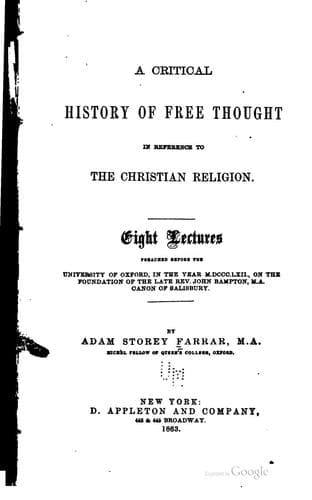
History of Free Thought in Reference to The Christian ReligionFarrar, Adam Storey
History
History of Free Thought in Reference to The Christian Religion
Farrar, Adam Storey
Free thought -- History
One of his most celebrated works was an explanation of “the true gospel of
Jesus Christ,” which is one of the many instances which his works afford
of the unfairness produced by the want of moral insight into the woes for
which Christianity supplies a remedy, and into the deep adaptation of the
scheme of redemption to effect the object proposed by a merciful
Providence in its communication.(464) It will be perceived that the three
last writers whose systems have been explained, resemble each other so
much as to form a class by themselves. They restrict their attack to the
internal character of revelation, employ the moral rather than the
historical investigation, embody the chief speculations of their
predecessors, and offer, as has been already stated, a constructive as
well as a destructive system; morality or natural religion in place of
revealed.(465)
An anonymous work was published in 1744, which merits notice as indicating
a slight alteration in the mode of attack on the part of the deists. It
was entitled, _The Resurrection of Jesus considered_, and is attributed to
P. Annet, who died in the wretchedness of poverty.(466) It was designed in
reply to some of the defences of this subject which the writings of
Woolston and others had provoked. Its object was to show that the writings
which record the statement of Christ’s prediction of his own death are a
forgery; that the narrative of the resurrection is incredible on internal
grounds, and the variety in the various accounts of it are evidences of
fraud. It indicates the commencement of the open allegation of literary
imposture as distinct from philosophical error, which subsequently marked
the criticism of the French school of infidelity, and affected the English
unbelievers of the latter half of the century.
Deism had now reached its maximum. The attention of the age was turned
aside from religion to politics by the political dangers incident to the
attempts of the Pretender; and when Hume’s scepticism was promulgated in
1749 it was received without interest, and Bolingbroke’s posthumous
writings published in 1754 fell comparatively dead. These two names mark
the period which we called the decline of deism. Bolingbroke’s views(467)
however depict deistical opinions of the period when it was at its height,
and are a transition into the later form seen in Hume, and therefore
require to be stated first, though posterior in the date of publication.
Public-domain text, read in full here on John Shaqi.
Reviews
Reviews
No reviews yet
Be the first to share your thoughts on this work.
Elsewhere in the archive
Join the Discussion
Join the discussion
Sign in to leave a comment or review.
Sign InorCreate an account