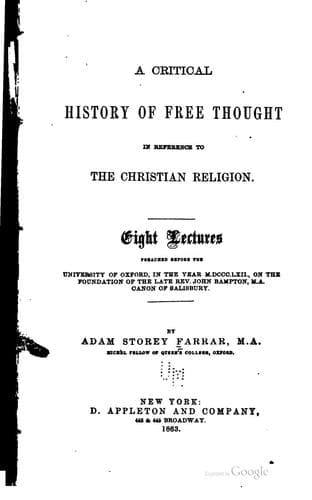
History of Free Thought in Reference to The Christian ReligionFarrar, Adam Storey
History
History of Free Thought in Reference to The Christian Religion
Farrar, Adam Storey
Free thought -- History
Bolingbroke’s writings command respect from their mixture of clearness of
exposition with power of argument. They form also the transition to the
literature of the next age, in turning attention to history. Bolingbroke
had great powers of psychological analysis, but he despised the study of
it apart from experience. His philosophy was a philosophy of history. In
his attacks on revelation we have the traces of the older philosophical
school of deists; but in the consciousness that an historical, not a
philosophical, solution must be sought to explain the rise of an
historical phenomenon such as Christianity, he exemplifies the historic
spirit which was rising, and anticipates the theological inquiry found in
Gibbon; and, in his examination of the external historic evidence, both
the documents by which the Christian religion is attested, and the effects
of tradition in weakening historic data, he evinces traces of the
influence of the historical criticism which had arisen in France under his
friend Pouilly.(468)
His theological writings(469) are in the form of letters, or of essays,
the common form of didactic writings in that age. We shall briefly state
his views on deity, futurity, and revelation.
He teaches the existence of a deity, but was led, by the sensational
philosophy which he adopted from Locke, to deny the possibility of an _à
priori_ proof of the divine existence,(470) and contends strongly that the
divine attributes can only be known by observation of nature, and not by
the analogy of man’s constitution. He considers too that the deity whose
existence he has thus allowed, exercises a general but not a special
providence;(471) the world being a machine moving by delegated powers
without the divine interference. The philosophy expressed in Pope’s
didactic poetry gives expression to Bolingbroke’s opinions(472) on
providence.
In his views of human duty Bolingbroke refers conduct to self-love as a
cause, and to happiness as an end; and doubts a future state,(473) either
on the ground of materialism, or possibly because his favourite principle,
that “whatever is, is best,” led him to disbelieve the argument for a
future life adduced from the inequality of present rewards. Future
punishment is rejected, on the ground that it can offer no end compatible
with the moral object of punishment, which is correction.
Public-domain text, read in full here on John Shaqi.
Reviews
Reviews
No reviews yet
Be the first to share your thoughts on this work.
Elsewhere in the archive
Join the Discussion
Join the discussion
Sign in to leave a comment or review.
Sign InorCreate an account