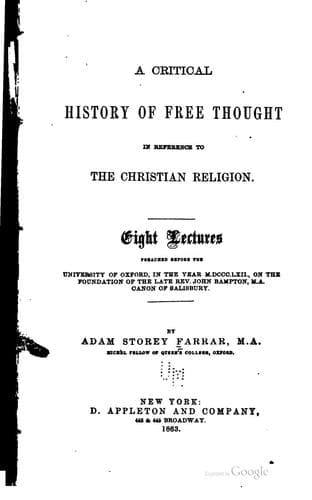
History of Free Thought in Reference to The Christian ReligionFarrar, Adam Storey
History
History of Free Thought in Reference to The Christian Religion
Farrar, Adam Storey
Free thought -- History
When he passes from natural religion to revealed, he allows the
possibility of divine inspiration, but doubts the fact; rebuking those
however who doubt things merely because they cannot understand them. In
criticising the Jewish revelation,(474) he puts no limits to his words of
severity. He dares to pronounce the Jewish history to be repugnant to the
attributes of a supreme, all-perfect Being. His attack on the records is
partly on account of the materials contained in them, such as the
narrative of the fall, the numerical statistics, the invasion of the
Canaanites, the absence of eternal rewards as sanctions of the Mosaic law;
and partly on the ground of the evidence being, as he alleges, not
narrated by contemporaries. In giving his opinion of Christianity, he
repeats the weak objection already used by Chubb, of a distinction
existing between the gospel of Christ and of Paul;(475) and tries to
explain the origin of Christianity and of its doctrines, suggesting the
derivation of the idea of a Trinity from the triadic notions of other
religions. But he is driven to concede some things denied by former
deists. He grants, for example, that if the miracles really occurred, they
attest the revelation;(476) and he therefore labours to show that they did
not occur, by attacking the New Testament canon(477) as he had before
attacked the Old; attempting to show that the composition of the gospels
was separated by an interval from the alleged occurrence of the events;
applying, in fact, Pouilly’s incipient criticism on history which has been
so freely used in theology by more recent critics.
These remarks will exhibit Bolingbroke’s views, both in their cause and
their relation to those of former deists. It will be observed that they
are for the most part a direct result either of sensational metaphysics or
of the incipient science of historical criticism.
The inquiry was now becoming more historical on the part both of deists
and Christians. Philosophy was still the cause of religious controversy,
but it had changed in character. It was now criticism weighing the
evidence of religion rather than ethics or metaphysics testing the
materials of it. The question formerly debated had been, how much of the
internal characteristics of scripture can be supported by moral
philosophy; and when the conviction at length grew up, that the mysteries
could not be solved by any analogy, but were unique, it became necessary
to rest on the miraculous evidence for the existence of a revelation, and
make the fact guarantee the contents of it. Inasmuch however as the
revelation is contained in a book, it became necessary to substantiate the
historical evidence of its genuineness and authenticity. Bolingbroke’s
attacks are directed against a portion of this literary evidence.
Public-domain text, read in full here on John Shaqi.
Reviews
Reviews
No reviews yet
Be the first to share your thoughts on this work.
Elsewhere in the archive
Join the Discussion
Join the discussion
Sign in to leave a comment or review.
Sign InorCreate an account