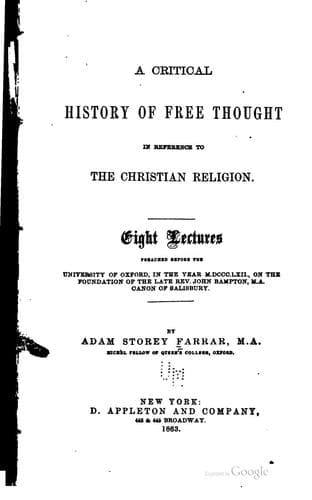
History of Free Thought in Reference to The Christian ReligionFarrar, Adam Storey
History
History of Free Thought in Reference to The Christian Religion
Farrar, Adam Storey
Free thought -- History
Historical criticism, in its appreciation of literary evidence, may be of
four kinds. It may (1) examine the record from a dogmatic point of view,
pronouncing on it by reference to prepossessions directed against the
facts; or (2) make use of the same method, but direct the attack against
the evidence on which the record rests; or (3) it may examine whether the
record is contemporary with the events narrated; or (4) consider its
internal agreement with itself or with fact.
We have instances of each of these methods in the examination of the
literary evidence on which miracles are believed. The first, the
prepossession concerning the philosophical impossibility of miracles, is
seen in Spinoza; the second, the impossibility of using testimony as a
proof of them, in Hume; the third, the question whether they were attested
by eyewitnesses, is the ground which Bolingbroke touches; the fourth, the
cross-examination of the witnesses, is seen in Woolston. Of these, the
first most nearly resembles the great mass of the deist objections to
revelation, being philosophical rather than critical. The second forms a
transition to the two latter, being philosophy applied to criticism, and
is the form which deism now took. The two latter are those which it
subsequently assumed.(478)
These remarks will explain Hume’s position,(479) and show how he forms the
transition between two modes of inquiry; his point of view being critical,
the cause of it philosophical. His speculations in reference to religion
are chiefly contained in his Essays on the Human Understanding. A brief
explanation is necessary to show the dependence of his theology on his
philosophy.
The speculations of Locke, as we have before had occasion to notice, gave
an impulse to psychological investigations. He clearly saw that knowledge
is limited by the faculties which are its source, which he considered to
be reducible to sensation and reflection; but while denying the existence
of innate ideas, he admitted the existence of innate faculties. Hartley
carried the analysis still farther, by introducing the potent instrument
offered by the doctrine of the association of ideas. Hume, adopting this
principle, applied it, in a manner very like the independent
contemporaneous speculations of Condillac in France, to analyse the
faculties themselves into sensations, and to furnish a more complete
account of the nature of some of our most general ideas, such, for
example, as the notion of cause. The intellectual element implied in
Locke’s account of the process of reflection here drops out. Faculties are
regarded as transformed sensations; the nature of knowledge as coextensive
with sensation. According to such a theory therefore, the idea of physical
cause can mean nothing more than the invariable connexion of antecedent
and consequent. The notion of force or power which we attach to causation
becomes an unreality; being an idea not given in sensation, which can
merely detect sequence.
Public-domain text, read in full here on John Shaqi.
Reviews
Reviews
No reviews yet
Be the first to share your thoughts on this work.
Elsewhere in the archive
Join the Discussion
Join the discussion
Sign in to leave a comment or review.
Sign InorCreate an account