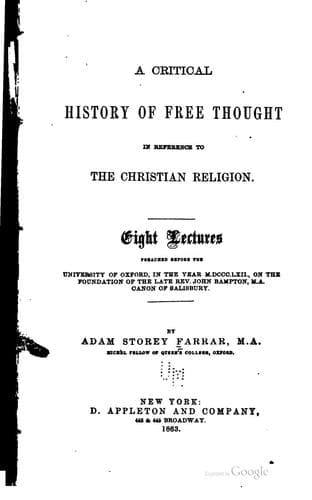
History of Free Thought in Reference to The Christian ReligionFarrar, Adam Storey
History
History of Free Thought in Reference to The Christian Religion
Farrar, Adam Storey
Free thought -- History
Such was Hume’s psychology; an attempt to push analysis to its ultimate
limits; valuable in its method, even if defective in its results; a
striking example of the acuteness and subtle penetration of its author.
There is another branch of his philosophy in which he is regarded as a
metaphysical sceptic, in reference to the passage of the mind outwards, by
means of its own sensations and ideas, into the knowledge of real being,
wherein he takes part with Berkeley, extending to the inner world of soul
the scepticism which that philosopher had applied to the outer world of
matter. In the psychological branch Hume is a sensationalist, in the
ontological a sceptic. The latter however has no relation to our present
subject. It is from the former that his views on religion are deduced. In
no writer is the logical dependence of religious opinion on metaphysical
principles visible in a more instructive manner. For we perceive that the
influence adverse to religion in his case was not merely the result of
rival metaphysical dogmas opposed to religion, such as were seen in the
Pantheists of Padua, or in Spinoza; nor even the opposition caused by the
adoption of a different standard of truth for pronouncing on revelation,
as in his fellow English deists; but it sprung from the application of the
subjective psychological inquiry into the limits of religious knowledge,
as a means for criticising not only the logical strength of the evidence
of religion, but specially the historic evidence of testimony. We
consequently see the influence exercised by the subjective branch of
metaphysical inquiries in the discussion not only of the logic of
religion, but also of the logic of the historic aspect of it.
Hume’s religious speculations(480) relate to three points:—to the argument
for the attributes of God, drawn from final causes; to the doctrine of
Providence, and future rewards and punishments; and to the evidence of
testimony as the proof of miracles. Though he does not conduct an open
assault in reference to any of them, but only suggests doubts, yet in each
case his insinuations sap so completely the very proof, that it is clear
that they are intended as grounds not merely for doubt, but for disbelief.
His doctrine of sensation is the clue to his remarks on the two former. He
argues that we can draw no sound inferences on the questions, because the
subjects lie beyond the range of sensational experience. It is however in
consequence of his remarks on the last of the three subjects in his essay
on Miracles that his name has become famous in the history of free
thought.
Public-domain text, read in full here on John Shaqi.
Reviews
Reviews
No reviews yet
Be the first to share your thoughts on this work.
Elsewhere in the archive
Join the Discussion
Join the discussion
Sign in to leave a comment or review.
Sign InorCreate an account