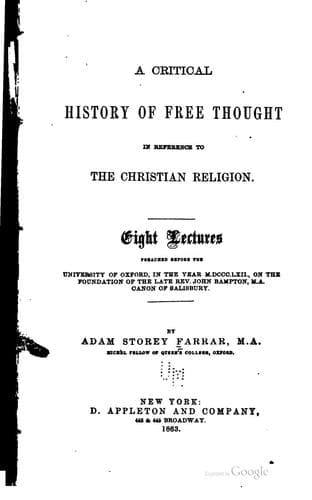
History of Free Thought in Reference to The Christian ReligionFarrar, Adam Storey
History
History of Free Thought in Reference to The Christian Religion
Farrar, Adam Storey
Free thought -- History
3. After a general preliminary idea of the history has been obtained from
these sources, in order to prevent being confused with details; it is
necessary to resort next to the original sources of information, without
careful study of which the history must lack a real basis.
In reference to the early unbelievers, the direct materials are lost; but
the contemporary replies to these writings remain. In the case of later
unbelievers, both the works and the answers to them exist. It will be
presumed that in so large a subject the writer cannot have read all the
sceptical works which have been written, and are here named. With the
exception however of Averroes and of the Paduan school,(27) in which cases
he has chiefly adopted second-hand information, and merely himself
consulted a few passages of the original writers, he has in all other
instances read the chief works of the sceptical writers, sufficiently at
least to make himself acquainted with their doubts, and in many cases has
even made an analysis of their works. The reader will perceive by the
foot-notes the instances in which this applies.
It may be due to some of the historians who have made a special study of
particular periods from original sources, to state, that so far as his
limited experience extends he can bear witness to their exactness.
Leehler’s work on English deism, for example,(28) is a singular example of
truthful narrative; and Leland’s,(29) though controversial, is worthy of
nearly the same praise.
4. There remains a fourth source of materials in the separate monographs
on particular men, opinions, or schools of thought. We shall enumerate
these according to the order of the lectures; dwelling briefly on the
majority of them, as being described elsewhere; and describing at greater
length those only which relate to the history of the theological movements
in Germany described in Lectures VI. and VII.; inasmuch as references are
there frequently made to these works without a specific description of
their respective characters.
In relation to the early struggle of Paganism against Christianity,(30)
the work of Lardner, _Collection of Ancient Jewish and Heathen Testimonies
to the Truth of the Christian Religion_ (1764-7) (Works, vols. vii.-ix.),
is well known for carefulness of treatment and the value of its
references. Portions also of the works of J. A. Fabricius, especially his
_Bibliotheca Græca_ and _Lux Evangelii_ (1732) are useful in reference to
the lost works, and for bibliographical knowledge: also a monograph by
Kortholt, _Paganus Obtrectator_ (1703), on the objections made by
Christians in the early ages, gathered from the Apologies.
Public-domain text, read in full here on John Shaqi.
Reviews
Reviews
No reviews yet
Be the first to share your thoughts on this work.
Join the Discussion
Join the discussion
Sign in to leave a comment or review.
Sign InorCreate an account