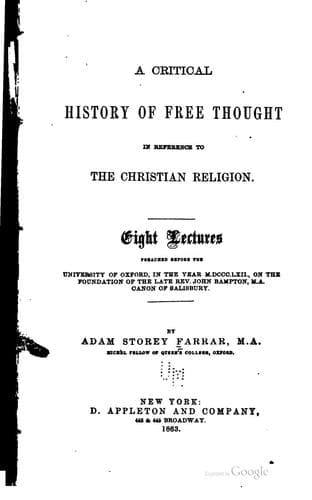
History of Free Thought in Reference to The Christian ReligionFarrar, Adam Storey
History
History of Free Thought in Reference to The Christian Religion
Farrar, Adam Storey
Free thought -- History
In this, as in the former case, it is only in modern times that important
notices occur concerning forms of unbelief. The circumstance that in the
early ages unbelief took the form of opposition or persecution on the part
of heathens, and that in the middle ages it was so rare, caused the
ancient church historians and mediæval church chroniclers to record little
respecting actual unbelief, though they give information about heresy.
Even in modern times, it is not till the early part of the eighteenth
century that any attention is bestowed on the subject. The earlier
historians, both Protestant, such as the Magdeburg Centuriators, and
Catholic, like Baronius, wrote the history of the past for a controversial
purpose in relation to the contests of their own times: and in the next
period, in the one church, Arnold confined himself to the history of
heresy rather than unbelief; and in the other, Fleury and Tillemont wrote
the history of deeds rather than of ideas, and afford no information,
except in a few allusions of the latter writer to the early intellectual
opposition of the heathens.
But about the middle of the eighteenth century, in the period of cold
orthodoxy and solid learning which immediately preceded the rise of
rationalism, as well as in that of incipient free thought, we meet not
only with the historians of theological literature already named above,
but with historians of thought like Brucker, and of the church like
Mosheim, possessed of large taste for inquiry, and wide literary
sympathies, who contribute information on the subject: and towards the
close of the century we find Schröckh, who, in his lengthy and careful
history of the church since the Reformation,(25) has taken so extensive a
view of the nature of church history, that he has included in it an
account of the struggle with freethinkers. Among the same class, with the
exception that he differs in being marked by rationalist sympathies, must
be ranked Henke.(26)
In the present century the spread of the scientific spirit, which counts
no facts unworthy of notice, together with the attention bestowed on the
history of doctrine, and the special interest in understanding the
fortunes of free thought, which sympathy in danger created during the
rationalist movement, prevented the historians from passing lightly over
so important a series of facts. It may be sufficient to instance, in
proof, the notices of unbelief which occur in Neander’s _Church History_.
General histories also of literature, like Schlosser’s _History of
Literature in the Eighteenth Century_, or the more theological one of
Hagenbach (_Geschichte des 18__n__ Jahrhunderts_) incidentally afford
information.
The various works just named are the chief of this class which furnish
assistance.
Public-domain text, read in full here on John Shaqi.
Reviews
Reviews
No reviews yet
Be the first to share your thoughts on this work.
Join the Discussion
Join the discussion
Sign in to leave a comment or review.
Sign InorCreate an account