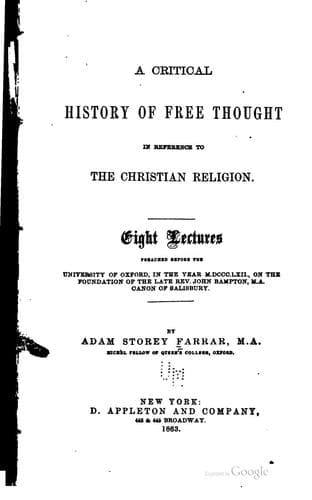
History of Free Thought in Reference to The Christian ReligionFarrar, Adam Storey
History
History of Free Thought in Reference to The Christian Religion
Farrar, Adam Storey
Free thought -- History
The reign of atheism in religion was fortified by a philosophy; and the
works of one infidel writer preserve the expression of the view which it
took of Christianity and religion. As soon as the excitement of the
revolution allowed leisure to return to the study of mental facts, there
arose the extreme form of sensationalism, which was called (in a different
meaning from the present popular use of the term) Ideology, (24). Cabanis
and Destutt de Tracy are the best exponents of its physiological and
psychological aspects; and the well-known Volney of its moral and
religious side. Starting from the principles of Condillac and Helvetius,
that the very faculties as well as ideas are derived from sensation, and
moral rules from self-love, it almost reaches the same point as D’Holbach.
Mental science was approached from the physiological side, and so viewed
that mind seemed to be made a property of brain.(594)
The chief work in which Volney expresses his unbelief is entitled the
“Ruins, or Meditations on the Revolutions of Empires.”(595) It is a poem
in prose. Volney imagines himself falling into a meditation, amid the
ruins of Palmyra, on the fall of empires.(596) The phantom of the ruins
appears, and, entering into converse with him, causes him to see the
kingdoms of the world, and guides him in the solution of the mysteries
which puzzle him.(597) It unveils to him the view of nature as a system of
laws, and of man as a being gifted with self-love. It traces the origin of
society in a manner not unlike Rousseau,(598) and refers the source of
evil to self-love; states the cause of ancient prosperity and decline, and
draws the moral lesson from the past.(599) While Volney is despondent at
the prospect of the future, a vision is unveiled to him of a new age. It
is of a nation ridding itself of privileged classes, and arming itself
when its young liberties were threatened by foreign powers.(600) It is an
apocalyptic vision of France in his time. Then suddenly the vision
changes, and an assembly of the nations of the world is gathered as in one
common arena, to ascertain how they may arrive at unity and peace.(601)
Their differences are illustrated by the discrepant opinions which they
utter on religion; and the origin of each religion on the earth is
traced.(602) It is here that Volney makes his speaker convey his own
scepticism. He tracks the origin of the religious ideas(603) through the
worship prompted by fear of the physical elements(604) and the stars(605)
to that of symbols or idols,(606) with its accompanying mysteries and
orders of priests; and then onward through dualism(607) to the belief of
an unseen world;(608) then through mythology(609) and pantheism(610) to
the belief in a Creator;(611) next, to Judaism(612) as the worship of the
soul of the world; and lastly, through the Persian(613) and Hindu(614)
systems to Christianity,(615) which he attempts to show to be the worship
of the sun under the cabalistic names of Christ and Jesus.
Public-domain text, read in full here on John Shaqi.
Reviews
Reviews
No reviews yet
Be the first to share your thoughts on this work.
Elsewhere in the archive
Join the Discussion
Join the discussion
Sign in to leave a comment or review.
Sign InorCreate an account