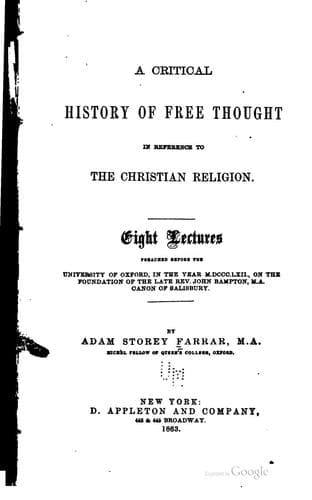
History of Free Thought in Reference to The Christian ReligionFarrar, Adam Storey
History
History of Free Thought in Reference to The Christian Religion
Farrar, Adam Storey
Free thought -- History
The theological movement has contributed nothing of permanent literary
value. The few apologies written were unimportant; and the thoughts of
those who attacked Christianity were neither new nor characterised by
depth. Their criticism was shallow, and was marked by the feature of which
traces were observed in a few English authors, the disposition to charge
imposture on the writers of the holy scriptures; so that they not only
failed to appreciate the literary excellence of the works, but scarcely
even allowed the possibility of unintentional deception on the part of the
writers. The doubts were chiefly the reproduction of the English point of
view, with the addition of a few physical difficulties;(617) protests of
free thought against dogma in natural science. The view entertained
concerning deity was eventually grovelling; the greatness of nature seemed
to inspire no reverence. Unbelief gradually lost hold of monotheism; and
in doing so never ascended in grandeur to the idea of pantheism, but fell
into blank atheism. The theoretical morality of the English deists, even
when depending on expedience, was noble; but in place of it the French
school presented the lowest form of theory which ethical science has ever
stated, and which finds its refutation with the philosophy that gave it
birth.
No age exhibits a body of sceptical writers whose characters are so
unattractive as the French unbelievers; whose coarseness of mind in
failing to appreciate that which is beautiful in Christianity is so
evident, that charity could not forbid us to doubt, even if there were not
independent proof, that faults of character contributed very largely to
the formation of their unbelief. Nevertheless, the political aspect of the
movement carries a solemn warning to the Christian church, not to endanger
the everlasting Gospel of the Son of God by making it the buttress to
support corrupt political and ecclesiastical institutions. It is true that
Christ will not abandon his true church. Whatever is divine and eternally
true will always as in this case survive the catastrophe. But this period
of history shows that Providence will not work a miracle to save religion
from a temporary eclipse, if the church forgets that Christ’s kingdom is
not of this world; and that the mission which he has given it is to
convert souls to him; and that learning and piety are intellectual and
moral means for effecting this object.(618) The political faults or
shortcomings of the church are no apology for the infidelity of France;
but they must be taken into account in explaining its intensity.
A theological movement so vast could not fail to exercise an influence in
other lands. Incidental allusions have already been made to its effects at
the court of Prussia,(619) and to the traces of its tone in some of the
later of the English deists.
-------------------------------------
Public-domain text, read in full here on John Shaqi.
History of Free Thought in Reference to The Christian Religion — John Shaqi
Reviews
Reviews
No reviews yet
Be the first to share your thoughts on this work.
Elsewhere in the archive
Join the Discussion
Join the discussion
Sign in to leave a comment or review.
Sign InorCreate an account