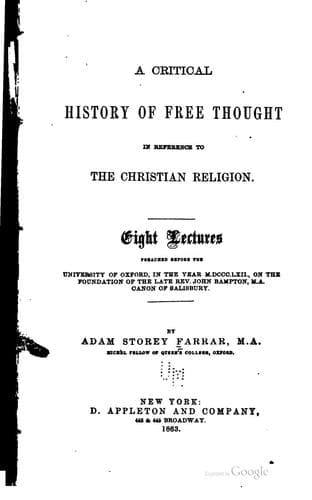
History of Free Thought in Reference to The Christian ReligionFarrar, Adam Storey
History
History of Free Thought in Reference to The Christian Religion
Farrar, Adam Storey
Free thought -- History
The Age of Reason, was a pamphlet admitting of quick perusal. It was
afterwards followed by a second part, in which a defence was offered
against the replies made to the former part. The object of the two is to
state reasons for rejecting the Bible,(632) and to explain the nature of
the religion of deism,(633) which was proposed as a substitute. A portion
is devoted to an attack on the external evidence of revelation, or, as the
author blasphemously calls it,(634) “the three principal means of
imposture,” prophecy, miracles, and mystery; the latter of which he
asserts may exist in the physical, but not by the nature of things in the
moral world. A larger portion is devoted to a collection of the various
internal difficulties of the books of the Old and New Testament, and of
the schemes of religion, Jewish and Christian.(635) The great mass of
these objections are those which had been suggested by English or French
deists, but are stated with extreme bitterness. The most novel part of
this work is the use which Paine makes of the discoveries of
astronomy(636) in revealing the vastness of the universe and a plurality
of globes, to discredit the idea of interference on behalf of this
insignificant planet,—an argument which he wields especially against the
doctrine of incarnation. But no part of his work manifests such
bitterness, and at the same time such a specious mode of argument, as his
attack on the doctrine of redemption and substitutional atonement.(637)
The work, in its satire and its blasphemous ribaldry, is a fit parallel to
those of Voltaire. Every line is fresh from the writer’s mind, and written
with an acrimony which accounts for much of its influence. The religion
which Paine substituted for Christianity was the belief in one God as
revealed by science, in immortality as the continuance of conscious
existence, in the natural equality of man, and in the obligation of
justice and mercy to one’s neighbour.(638)
The influence of the spirit of Paine lingered in some strata of our
population far into the present century: by means of the views of
Owen,(639) the founder of English socialism, which essentially reproduce
the visionary political reforms which belonged to the philosophy and to
the doubt of the last century.
Public-domain text, read in full here on John Shaqi.
Reviews
Reviews
No reviews yet
Be the first to share your thoughts on this work.
Elsewhere in the archive
Join the Discussion
Join the discussion
Sign in to leave a comment or review.
Sign InorCreate an account