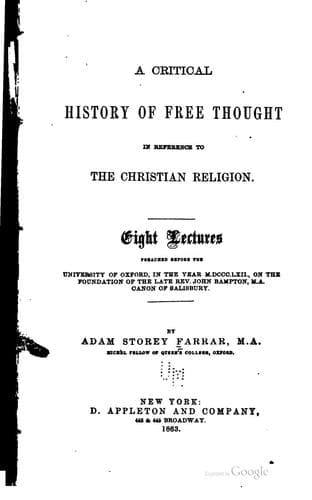
History of Free Thought in Reference to The Christian ReligionFarrar, Adam Storey
History
History of Free Thought in Reference to The Christian Religion
Farrar, Adam Storey
Free thought -- History
Being desirous to improve the condition of the industrial classes, Owen
speculated on the causes of evil; and, approaching the subject from the
extreme sensational point of view, regarded the power of circumstances to
be so great, that he was led to regard action as the obedience to the
strongest motive. He thus introduced the idea of physical causation into
the human will; and made the rule of right to be each one’s own pleasures
and pains. Founding political inferences on this ethical theory of
circumstantial fatalism, he proposed the system called socialism, which
aimed at modifying temptations and removing two great classes of
temptations, by facilitating divorce, and proposing equality of property.
The system is now obsolete both in idea and in history, yet it has an
interest from the circumstance that until recently it deceived the minds
and corrupted the religious faith of many of the manufacturing population.
The history of the influence of French infidelity on the course of English
thought closes with names of greater note.(640) If Owen, though belonging
to the present century, represents the political tone of the past, we must
also refer to the same period, morally though not chronologically, the
spirit of unbelief which animated literature in the poetry of Byron and
Shelley.
Saddened by blighted hopes, political and personal, Byron affords a type
of the unbelief which is marked by despair.(641) If compared with the two
exiles of the Leman lake, whom the sympathy of a common scepticism and
common exile commended to his meditation, he stands in many respects
widely contrasted with them in tone and spirit. Allied rather to Gibbon in
seriousness, he nevertheless wholly lacked his moral purpose and resolute
spirit of perseverance. More nearly resembling Voltaire in the nature of
his unbelief, he nevertheless differed in the features of gloom by which
his mind was characterized. His unbelief was a remnant of the philosophic
atheism of France; but it received a tinge in passing through the wounded
mind of the poet.
His brother poet, of a still loftier genius, is more widely contrasted
with him in mental qualities, than united by similarity in the character
of his unbelief. Both were weary of the world; but the one was drawn down
by unbelief to earth, the other soared into the ideal: the one was driven
to the gloom of despair, the other was excited by the imagination to the
madness of enthusiasm: the one was made sad by disappointment, the other
was goaded by it into frenzy.
Shelley merits more than a passing notice, both because his poetry is a
proof of our main position concerning the influence of certain forms of
philosophy in producing unbelief, and because his mental history, as
learned by means of his works and memoirs, is a psychological study of the
highest value. The infidelity which shows itself in him is an _idolum
specûs_, as well as an _idolum theatri_.(642)
Public-domain text, read in full here on John Shaqi.
Reviews
Reviews
No reviews yet
Be the first to share your thoughts on this work.
Elsewhere in the archive
Join the Discussion
Join the discussion
Sign in to leave a comment or review.
Sign InorCreate an account