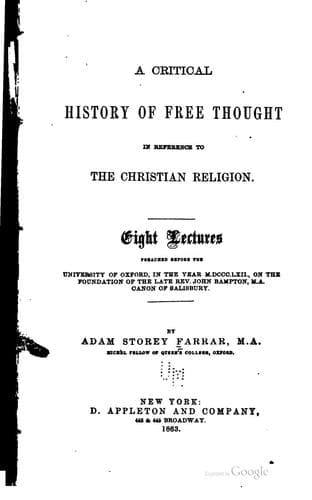
History of Free Thought in Reference to The Christian ReligionFarrar, Adam Storey
History
History of Free Thought in Reference to The Christian Religion
Farrar, Adam Storey
Free thought -- History
His life, his natural character, and his philosophy, all contributed to
form his scepticism.(643) His life is a tale of sorrow and ruined hopes,
of genius without wisdom: one of the sad stories which will ever excite
the sympathy of the heart. Early sent to this university, he seems like
Gibbon to have lived alone; and in the solitude of that impulsive and
recluse spirit which formed his life-long peculiarity, to have nursed a
spirit of atheism and wild schemes of reform. Charged by the authorities
of his college with the authorship of an atheistical pamphlet,(644) he was
expelled the university. An outcast from his family, he went forth to
suffer poverty, to gather his livelihood as he could by the wonderful
genius which nature had given him. Wronged as he thought by his university
and his country, his wounded spirit imputed the supposed unkindness which
he received to the religion which his enemies professed. In a foreign
land, brooding over his wrongs, he cherished the bitter antipathy to
priestcraft and to monarchy which finds such terrific expression in his
poems.(645) His end was a fit close of a tragic life. A friendly hand paid
the last office of friendship to his remains; and the urn which contains
the ashes of his pyre rests in the solemn and beautiful cemetery of the
eternal city, which he himself had described so strikingly in his
affecting memorial of his friend, the poet Keats.(646)
His natural character contributed to produce his scepticism not less than
his life to increase it. He has left us a clear delineation of himself in
his writings. If considered on the emotional side, he was a creature of
impulses. His predominant passion was an enthusiastic desire to reform the
world. Filled with the wildest ideas of the French revolution, his
impulsiveness hurried him on to give expression to them. His intellectual
nature was analogous to the moral, and itself received a stimulus from it.
His mental peculiarity was his power of sustained abstraction. His poems
are not lyrics of life, but of an ideal world. His tendency was to
insulate qualities or feelings, and hold them up to the mental vision as
personalities. The words which he has addressed to his own skylark fitly
describe his mind as it soared in the solitude of its abstraction:
Higher still and higher
From the earth thou springest,
And singing still dost soar, and soaring ever singest.
Public-domain text, read in full here on John Shaqi.
Reviews
Reviews
No reviews yet
Be the first to share your thoughts on this work.
Elsewhere in the archive
Join the Discussion
Join the discussion
Sign in to leave a comment or review.
Sign InorCreate an account