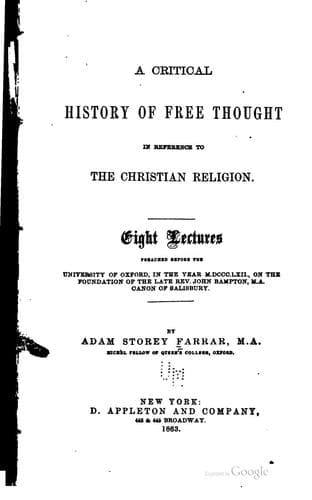
History of Free Thought in Reference to The Christian ReligionFarrar, Adam Storey
History
History of Free Thought in Reference to The Christian Religion
Farrar, Adam Storey
Free thought -- History
We have previously had occasion to imply, that the Protestant reformation
of the sixteenth century contained both an intellectual and a spiritual
element.(658) The attempt to reconcile these has been the problem of
protestant theology in Germany ever since. The intellectual element, so
far as it was literary, soon passed into the hands of lay scholars:(659)
the spiritual became a life rather than a doctrine, and the polemic or
dogmatic aspect of the intellectual movement alone was left. The time from
the passing of the Formula of Concord and the Synod of Dort(660) to the
beginning of the eighteenth century, a period nearly corresponding with
the seventeenth century, was in Germany an age of dogmatic theology. It
was scholasticism revived, with the difference that the only source for
the data of argument was the Scripture, not philosophy. But there was an
equal absence of inquiry into first principles, an equal appeal to
authority for the grounds of belief, and equal activity within these
prescribed limits. It was marked, as among the contemporary puritans in
England, by the most extreme view of biblical inspiration.(661) Not only
was the distinction of law and gospel overlooked, and the historic and
providential development in revelation forgotten; but Scripture was
supposed to be in all respects a guide for the present, as well as a
record of the past. Infallible inspiration was attributed to the authors
of the sacred books, not merely in reference to the religious instruction
which formed the appropriate matter of the supernatural revelation, but in
reference also to the allusions to collateral subjects, such as natural
science, or politics; and not merely to the matter, but to the smallest
details of the language of the books.
Public-domain text, read in full here on John Shaqi.
Reviews
Reviews
No reviews yet
Be the first to share your thoughts on this work.
Elsewhere in the archive
Join the Discussion
Join the discussion
Sign in to leave a comment or review.
Sign InorCreate an account