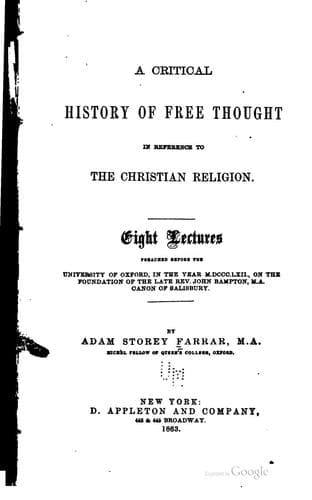
History of Free Thought in Reference to The Christian ReligionFarrar, Adam Storey
History
History of Free Thought in Reference to The Christian Religion
Farrar, Adam Storey
Free thought -- History
Contemporary with this scholastic spirit was an outburst of the living
spiritual feeling which had formed the other element in the Reformation.
This religious movement is denominated Pietism. (27) Its centre was at
Halle; and the best known name among the band of saints, of whom the world
was not worthy, was Spener. Soon after the time when the miseries of the
thirty years’ war were closing, he established schools for orphans, and a
system of teaching and of religious living which stirred up religious life
in Germany. These two tendencies—the dogmatic and the pietistic—marked the
religious life of Germany at the opening of the eighteenth century. The
inference has been frequently drawn by the German writers, that they
ministered indirectly to the production of scepticism; the dogmatic
strictness stimulating a reaction towards latitude of opinion, and the
unchurchlike and isolating character of pietism fostering individuality of
belief. This inference is however hardly correct. Dogmatic truth in the
corporate church, and piety in the individual members, are ordinarily the
safeguard of Christian faith and life. The danger arose in this case from
the circumstance that the dogmas were emptied of life, and so became
unreal; and that the piety, being separated from theological science,
became insecure.
During the first half of the century, certain new influences were
introduced, which in the latter half caused these tendencies to develope
into rationalism. They may be classed as three;(662)—the spread of the
speculative philosophy of Wolff; the introduction of the works of the
English deists; and the influence of the colony of French infidels
established by Frederick the Great in Prussia. We shall explain these in
detail.
Public-domain text, read in full here on John Shaqi.
Reviews
Reviews
No reviews yet
Be the first to share your thoughts on this work.
Elsewhere in the archive
Join the Discussion
Join the discussion
Sign in to leave a comment or review.
Sign InorCreate an account