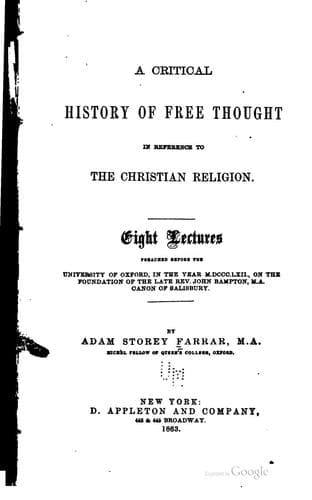
History of Free Thought in Reference to The Christian ReligionFarrar, Adam Storey
History
History of Free Thought in Reference to The Christian Religion
Farrar, Adam Storey
Free thought -- History
The philosophy of Wolff was an offshoot directly from Leibnitz, indirectly
from the Cartesian school. It is hardly necessary to reiterate the remark
that the revolution in thought wrought by Descartes was nothing less than
a protest of the human mind against any external authority for the first
principles of its belief. Two great philosophers followed out his method
in an independent manner; Spinoza, who attempted to exhibit with the
rigour of deduction the necessary development of the idea of substance
into the various modes which it assumes; and Leibnitz,(663) who, with less
attempt at formal precision of method, starting with the idea of power,
endeavoured, by means of the monadic theory, which it is unnecessary here
to explain, to exhibit the nature of the universe in itself, and the
connexion of the world of matter and of spirit. Wolff was a disciple of
Leibnitz; great as a teacher rather than an inventor, who invested the
system of his master slightly modified, with the precision of form which
raised it to rivalry with the perfect symmetry of Spinoza’s system.
Adopting his master’s two great canons of truth, the law of contradiction
as regulative of thoughts, and the law of the sufficient reason as
regulative of things,(664) he attempted in his theoretic philosophy to
work out a regular system on each of the great branches of
metaphysic,—nature, the mind, and God; by deducing them from the abstract
ideas of the human mind.(665) The true method of conducting this inquiry
would be strictly an _à posteriori_ one, an analytical examination of our
own consciousness, to ascertain what data the facts of the thinking mind
furnish with respect to things thought of. But without any such
examination Wolff, assuming in reference to these subjects the abstract
ideas of the human mind as his data, proceeded to reason from them with
the same confidence as the realists of the middle ages, or as
mathematicians when they commence with the real intuitions of magnitude on
which their science is founded. Thus his whole philosophy was form without
matter; a magnificent idea, but not a fact. Yet though really baseless, it
was not necessarily harmful.
Public-domain text, read in full here on John Shaqi.
Reviews
Reviews
No reviews yet
Be the first to share your thoughts on this work.
Elsewhere in the archive
Join the Discussion
Join the discussion
Sign in to leave a comment or review.
Sign InorCreate an account