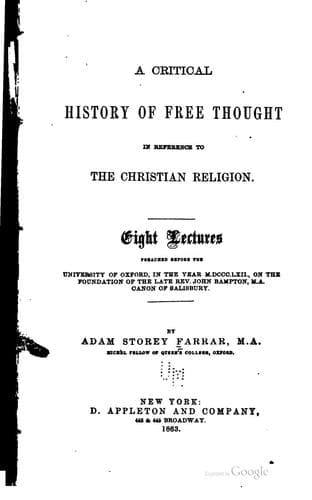
History of Free Thought in Reference to The Christian ReligionFarrar, Adam Storey
History
History of Free Thought in Reference to The Christian Religion
Farrar, Adam Storey
Free thought -- History
This philosophy at first met with much opposition from the pietistic party
of Halle.(666) The opposition was not due to any theological
incorrectness, for Wolff was an orthodox Christian; but arose from the
narrow and unnecessary suspicions which religious men too often have of
philosophy, and the sensibility to any attempt to suggest a
reconsideration of the grounds of belief, even if the conclusion adopted
be the same. But the system soon became universally dominant. Its orderly
method possessed the fascination which belongs to any encyclopædic view of
human knowledge. It coincided too with the tone of the age. Really
opposed, as Cartesianism had been in France, to the scholasticism which
still reigned, its dogmatic form nevertheless bore such external
similarity to it, that it fell in with the old literary tastes. The evil
effects which it subsequently produced in reference to religion were due
only to the point of view which it ultimately induced. Like Locke’s work
on the reasonableness of Christianity, it stimulated intellectual
speculation concerning revelation. By suggesting attempts to deduce _à
priori_ the necessary character of religious truths, it turned men’s
attention more than ever away from spiritual religion to theology. The
attempt to demonstrate everything caused dogmas to be viewed apart from
their practical aspect; and men being compelled to discard the previous
method of drawing philosophy out of scripture, an independent philosophy
was created, and scripture compared with its discoveries.(667) Philosophy
no longer relied on scripture, but scripture rested on philosophy.
Dogmatic theology was made a part of metaphysical philosophy. This was the
mode in which Wolff’s philosophy ministered indirectly to the creation of
the disposition to make scriptural dogmas submit to reason, which was
denominated rationalism. The empire of it was undisputed during the whole
of the middle part of the century, until it was expelled towards the close
by the partial introduction of Locke’s philosophy,(668) and of the system
of Kant, as well as by the growth of classical erudition, and of a native
literature.
The second cause which ministered to generate rationalism was English
deism. The connexion of England with Hanover had caused several of the
works of the English deists to be translated in Germany,(669) and the
general doctrines of natural religion, expressed by Herbert and Toland,
were soon reproduced, together with the difficulties put forth by Tindal.
But the direct effect of this cause has probably been exaggerated by the
eagerness of those who, in the wish to identify German rationalism with
English deism, have ignorantly overlooked the wide differences in
premises, if not in results, which separated them, and the regular
internal law of logical development which has presided over the German
movement.
Public-domain text, read in full here on John Shaqi.
Reviews
Reviews
No reviews yet
Be the first to share your thoughts on this work.
Elsewhere in the archive
Join the Discussion
Join the discussion
Sign in to leave a comment or review.
Sign InorCreate an account