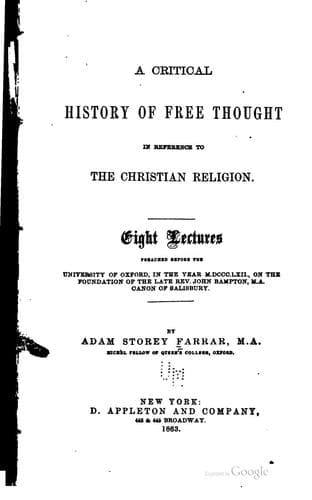
History of Free Thought in Reference to The Christian ReligionFarrar, Adam Storey
History
History of Free Thought in Reference to The Christian Religion
Farrar, Adam Storey
Free thought -- History
A more direct cause was found about the middle of the century in the
influence of the French refugees and others, whom Frederick the Great
invited to his court. Not only were Voltaire and Diderot visitors, but
several writers of worse fame, La Mettrie, D’Argens, Maupertuis,(670) who
possessed their faults without their mental power, were constant
residents. Their philosophy and unbelief were the miniature of that which
we have detailed in France. They created an antichristian atmosphere about
the court, and in the upper classes of Berlin; and even minds that were
attempting to create a native literature, and to improve the critical
standard of literary taste, were partially influenced by means of it.(671)
We have now seen the state of the German mind in reference to theology at
the beginning of the eighteenth century, and the three new influences
which were introduced into it in the interval between 1720 and 1760. The
dogmatic tendency became transformed by the Wolffian philosophy; the
pietistic retired from a public movement into the privacy of life; while
the minds of men were awakened to inquiry by the suggestions of the
English deists, or the restless and hopeful tone of the French mind. It
was a moment of transition; the streaks of twilight before the dawn. Yet
the signs of a change were so slight, that few could as yet discern the
coming of a crisis, none predict its form.
We may now proceed to give the history of the theological movement which
sprang up, commonly called Rationalism. It admits of natural division into
three parts. The first, a period destructive in its tendency, extending to
a little later than the end of the century, exhibits the gradual growth of
the system, and its spread over every department of theology. The second,
reconstructive in character, the re-establishment of harmony between faith
and reason, extends till the publication of Strauss’s celebrated work on
the Life of Christ in 1835; the third, containing the divergent tendencies
which have created permanent schools, reaches to the present time.(672) In
all alike the harmony of faith and reason was sought: but in the first it
was attained by sacrificing faith to reason; in the second and third, by
seeking for their unity, or by separating their spheres. A distinguished
name stands at the commencement of each period, representing the mind
whose speculations were most influential in giving form to the movements.
Semler inaugurated the destructive movement; Schleiermacher, the
constructive; and Strauss precipitated the final forms which theological
parties have assumed. In the present lecture we shall treat only of the
first two of these movements.
Public-domain text, read in full here on John Shaqi.
Reviews
Reviews
No reviews yet
Be the first to share your thoughts on this work.
Elsewhere in the archive
Join the Discussion
Join the discussion
Sign in to leave a comment or review.
Sign InorCreate an account