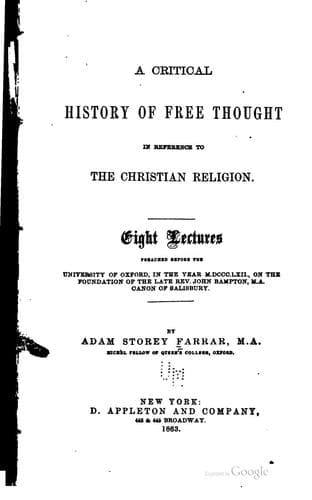
History of Free Thought in Reference to The Christian ReligionFarrar, Adam Storey
History
History of Free Thought in Reference to The Christian Religion
Farrar, Adam Storey
Free thought -- History
The first of these periods, extending; from about 1750 to 1810,(673)
contains two sub-periods. Till about 1790(674) we find the growth of
rationalism. In the last decade of the century we shall meet with its full
development; but at the same time the growth of new causes will be
perceived, which prepared the way for a total alteration after the
commencement of the present century.
The sub-period extending to 1790 is one of transition, in which we can
trace three broadly marked tendencies in religion; one within the church,
two outside of it. Such classes indeed slide away into each other; nature
is more complex than man; but the use of them may be excused as
facilitating instruction.
The movement within the church verged from a literary and dogmatic
orthodoxy, which existed chiefly at the Saxon university of Leipsic,
through the purely literary tendency, of which Michaelis may be taken as a
type in the newly formed university of Göttingen, to the freethinking
method typified by Semler, orthodox in doctrine, but in criticism adopting
free views of inspiration, which mingled itself with the old pietism of
the university of Halle.(675)
The two movements outside the church were, a literary one, indicated by
Lessing, which found its chief utterance in the periodical literature,
then in its infancy;(676) and a thoroughly deist one, connected with the
court of Berlin, embodied in the educational institutions of Basedow.(677)
The movement which we have just named as existing within the church,
differed from the older dogmatic one, in being a tendency toward an
historical and critical study of the scriptures, instead of a
philosophical study of doctrines. It embraced those whose teaching was not
at variance with Christianity, and also those who manifested incipient
scepticism. Two names, Ernesti(678) at Leipsic, and Michaelis(679) at
Göttingen, represent the first class; the former applying criticism
chiefly to the New Testament, the latter to the Old. The endeavour of
both, especially of Ernesti, was to revive the grammatical and literary
mode of interpreting scripture, as opposed to the dogmatic previously in
use. Their spirit was not sceptical, but was that of men who felt the
sceptical opinions round them; ethical and cold, like that of the
Arminians of the preceding century.
Their system developed into rationalism in the hands of two of their
pupils. Eichhorn was the pupil of Michaelis, Semler of Ernesti. The name
of Eichhorn will recur later; Semler(680) must be considered now.
Public-domain text, read in full here on John Shaqi.
Reviews
Reviews
No reviews yet
Be the first to share your thoughts on this work.
Elsewhere in the archive
Join the Discussion
Join the discussion
Sign in to leave a comment or review.
Sign InorCreate an account