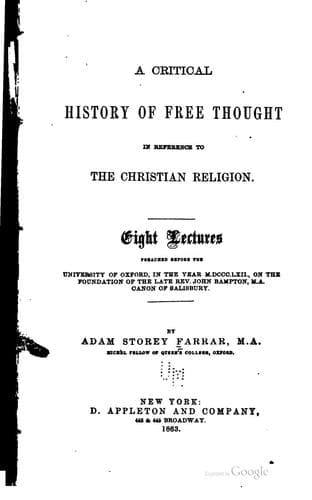
History of Free Thought in Reference to The Christian ReligionFarrar, Adam Storey
History
History of Free Thought in Reference to The Christian Religion
Farrar, Adam Storey
Free thought -- History
Semler was one of those minds which fall short of the highest order of
originality, but by their erudition and appreciation of the wants of their
time institute a movement by giving form to the current feeling of their
day. Nurtured in pietism, he always retained signs of personal excellence;
and his Christian earnestness is said not to have been destroyed by his
speculations. His autobiography furnishes us with the means for the full
comprehension of his character, and shows him to have been keenly alive to
the difficulties which the English literature had suggested. His labours
related to criticism, to exegesis, and to doctrine. As a critic he did not
restrict himself to the examination of texts, but investigated the
canonicity of the books of Scripture.(681) It is probable that the
criticism commenced by R. Simon and Spinoza furnished hints for his views.
He was one of the first to undervalue external evidence in the formation
of the canon. The determination of the canon, i.e. of the list of books
which are to be considered scripture, is a question of fact. What did the
early church pronounce to be such; and does internal evidence bear out the
idea? Semler undervalued the historical evidence of the church’s judgment,
and replaced it, not by careful study of internal critical evidence, like
later rationalism, but by an _à priori_ subjective decision, that only
such books were to be received as conduced to a religious object. But it
is in exegesis that he enunciated the principles which have left a
permanent effect. He established what is called the historical method of
interpretation.(682)
In the course of Christian history, three great methods for the
interpretation of scripture have been used; the allegorical, the dogmatic,
and the grammatical.(683) In the early church the tendency in the main was
to the allegorical; in the middle-ages to the dogmatic; at the Renaissance
and Reformation to the grammatical, which however in the seventeenth
century was displaced by the allegorical(684) and dogmatic; and it was the
work of Ernesti to restore it. Semler added the historic; by which is
meant the method, which, after discovering the grammatical sense of the
words, rests content exactly with the meaning which the circumstances of
society could permit scripture to have at that age. It declines to search
for mystical senses, or to use dogma as a clue to interpretation. This
principle, so valuable in itself, yet, when abused, so fruitful in
producing rationalism, was the discovery of Semler.
Public-domain text, read in full here on John Shaqi.
Reviews
Reviews
No reviews yet
Be the first to share your thoughts on this work.
Elsewhere in the archive
Join the Discussion
Join the discussion
Sign in to leave a comment or review.
Sign InorCreate an account