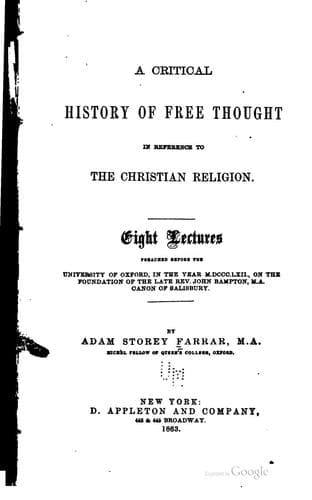
History of Free Thought in Reference to The Christian ReligionFarrar, Adam Storey
History
History of Free Thought in Reference to The Christian Religion
Farrar, Adam Storey
Free thought -- History
The application of this method of interpretation led him to the theory
generally known by the name of “accommodation.”(685) He felt a strong
reaction against the forgetfulness shown by the old dogmatic orthodoxy,
which had regarded the Bible as one book, instead of a collection or
historic series of books, and had confounded together the Jewish and
Christian dispensations, and taken no cognizance of the development of
religious knowledge in scripture. Accordingly he desired to remove the
deist difficulty by separating the eternal truth in scripture from what he
considered to be local(686) that the Mosaic law of divorce was an
adaptation to the particular needs of the age, seemed to establish the
validity of the principle that revelation was an accommodation to be
judged of by the historic circumstances of the age for which it was
intended. The principle had been applied by English theologians:(687) but
it needed a delicate insight to apply it safely. Semler introduced it
indiscriminately into prophecy, miracle, and doctrine; and stated his
views in a form which, though well meant, is certainly most repulsive. We
may cite an instance in the case of his view of the demoniacal possessions
of the New Testament.(688) Not denying them, Semler probably considered
them to be nothing but the diseases of epilepsy and madness. But he did
not ridicule the narrative as a deist would, nor explain the facts away as
legends or myths, as is the plan of the later schools, nor account for
them by the supposition that the apostles were left in ignorance about
physical science, and inspired only in religious knowledge; but he
regarded the narrative as an intentional accommodation on the part of the
teachers to their hearers, and consequently stated his views in a form
which is the more repulsive as seeming to impute dishonesty.(689) He went
so far as to consider some of the doctrines of the New Testament to be an
accommodation on the part of our Lord to the Jewish notions; and regarded
Christ’s work as the compromise between the Mosaic and philosophical
parties in the Jewish church, which afterwards were represented in the
Christian by St. Peter and St. Paul respectively.(690) Though he himself
held the apostles’ creed, and was shocked at some later developments of
unbelief,(691) yet he seems to have considered practical morality to be at
once the sole aim of Christianity, and the supreme rule of doctrine.(692)
He founded no school; but his influence decidedly initiated the
rationalist movement within the church; one peculiarity of which will be
found to be, that it was professedly designed in defence of the church,
not as an attack upon it.
Public-domain text, read in full here on John Shaqi.
Reviews
Reviews
No reviews yet
Be the first to share your thoughts on this work.
Elsewhere in the archive
Join the Discussion
Join the discussion
Sign in to leave a comment or review.
Sign InorCreate an account