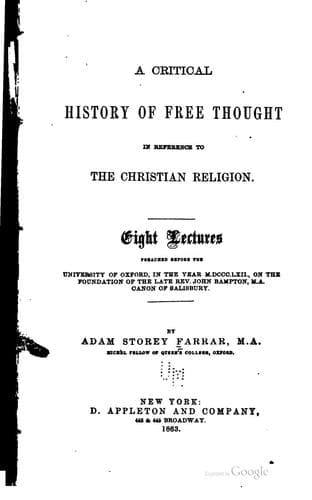
History of Free Thought in Reference to The Christian ReligionFarrar, Adam Storey
History
History of Free Thought in Reference to The Christian Religion
Farrar, Adam Storey
Free thought -- History
The tendency which we have just studied was within the church. The two now
about to be named were external to it. The one, earnest and scholarlike,
formed chiefly on the model of English deism, is represented by Lessing.
The other, modelled after Rousseau, was practical rather than
intellectual, and aimed at remodelling education as well as altering
belief.
Lessing,(693) a name honoured in the history of literature, is little
known in England, save by his exquisite comparison of art and poetry,
called the Laocoon.(694) He was one of those whose labours remain for the
benefit of other ages, like that of the coral worms, which die, but leave
their work. That a native German literature exists, is the work of Lessing
as pioneer; that it is worth studying, is the result of his criticism and
influence. Finding literature just arising, and the dispute still raging
between the Saxon and Swiss schools, whether it should model itself after
reason and form like the French literature, or after nature and the soul
like the English, (28) he showed the true mode of uniting the two by
turning attention to Greek models; and, in conjunction with Nicholai and
the Jewish philosopher Mendelssohn, established a critical periodical,
which became the agency for a literary reformation. But the point of
interest, in relation to our present subject, is his influence on
religion. Availing himself of the right which his position as librarian of
Wolfenbüttel, a small town near Brunswick, gave him to publish manuscripts
found in the library, he edited, in 1774 and the four following years,
several fragments of a larger work, which he professed to have found. They
are usually called the Wolfenbüttel fragments. (29) Till recently their
authorship remained a secret. They are now known to have been written by
the learned Hamburg philosopher, Reimarus.(695) They treated very nearly
the same subjects, and in much the same tone, but with consummate skill,
as the English deists. Reimarus, as is now known, in the introduction(696)
to the larger unprinted work from which they were extracted, gave his own
intellectual history, his early doubts on the doctrines of the Trinity,
and the destruction of the heathen; and also on the history of the Old and
New Testaments; and ends, like the English deists, with resting in natural
religion.
Public-domain text, read in full here on John Shaqi.
Reviews
Reviews
No reviews yet
Be the first to share your thoughts on this work.
Elsewhere in the archive
Join the Discussion
Join the discussion
Sign in to leave a comment or review.
Sign InorCreate an account