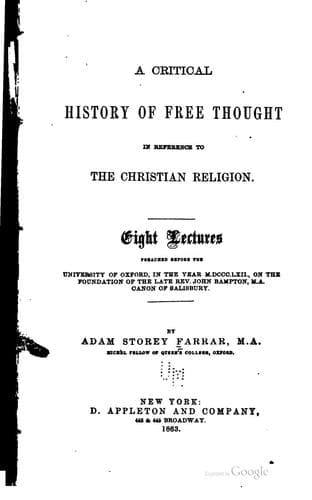
History of Free Thought in Reference to The Christian ReligionFarrar, Adam Storey
History
History of Free Thought in Reference to The Christian Religion
Farrar, Adam Storey
Free thought -- History
The first two(697) fragments, published by Lessing, touched only upon the
question of tolerating deists, and on the custom of declaiming against
human reason in the pulpits. The third referred to the impossibility that
all men should be brought to believe revelation on rational evidence. The
fourth and fifth attacked the Old Testament history, such as the passage
of the Red Sea. The sixth directed an assault against the New Testament;
pointing out with unsparing severity the discrepancies in the accounts of
the resurrection. The concluding one was on the object of Christianity, in
which our blessed Lord’s life and work were represented as a defeated
political reform.
These views however were not professedly sanctioned by Lessing, for he
added notes in refutation of them, and stated his object to be merely to
stimulate free inquiry.(698) His wish was gratified in the tremendous
effect which the publication produced. In the literary controversy which
ensued, and which embittered his few remaining days,(699) he explained
himself to be a doubter rather than a disbeliever; and defended himself by
urging the distinctness of the religious element in scripture from the
scientific; asserting that, as Christianity existed before the New
Testament, so it could exist after it. The Christian religion is not true,
he said, merely because evangelists and apostles taught it; but they
taught it because it is true. And in order to restore Christianity to its
true place in the estimation of thinking men, he composed or edited a
well-known work(700) on the Education of the World,(701) which became a
fertile source of thought for the philosophy of history, and was designed
to explain the function of the Jewish religion in reference to the
Christian, and to the world. The theology of Lessing’s coadjutors however,
if not also that of Lessing himself, did not rise higher than that of the
more serious among the English deists.(702)
The other tendency, more decidedly sceptical even than that of Lessing,
gave definite form to the extreme sceptical opinions excited by French
philosophy, which had been fermenting in German society, and had earlier
expressed themselves. It is best represented by Edelmann,(703) and by the
unhappy Bahrdt, who passed gradually from Semler’s school into this. Its
religions tenets were simple naturalism, moral as distinct from positive
religion; and it was connected with the attempt by Basedow,(704)
patronised by Frederick, to establish educational institutions on the
model proposed in Rousseau’s Emile. The name which it gave to the movement
was, the Period of Enlightenment (Aufklärung-zeit),(705) which expressed
the consciousness of illumination, and the yearning for deliverance which
was finding its expression in France; and this name therefore has been
usually adopted among foreign writers to describe this period of the
history.
Public-domain text, read in full here on John Shaqi.
Reviews
Reviews
No reviews yet
Be the first to share your thoughts on this work.
Elsewhere in the archive
Join the Discussion
Join the discussion
Sign in to leave a comment or review.
Sign InorCreate an account