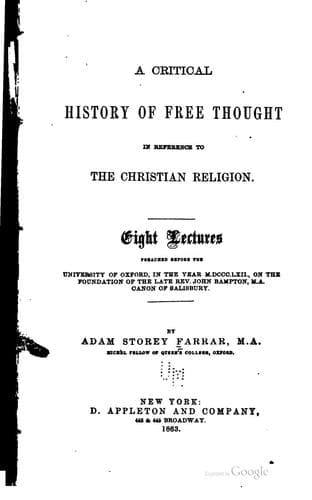
History of Free Thought in Reference to The Christian ReligionFarrar, Adam Storey
History
History of Free Thought in Reference to The Christian Religion
Farrar, Adam Storey
Free thought -- History
Such are the historical tendencies from about 1750 till about 1790—cold
but learned orthodoxy; the commencement of critical rationalism, and open
deism. About that time new influences came into operation, the effects of
which are at once evident. Without taking account of the excitement caused
by the political events of the French revolution, we may name two such new
causes of movement—the literary influence of the court of Weimar, and the
philosophy of Kant.
The centres of intellectual activity in Germany now changed. We are so apt
to forget that Germany, especially at the end of the last century, formed
a set of independent principalities, which varied in taste, in belief, and
in literary tone, that we fail to realise the individuality of the scenes
of literary activity. At the end of the last century there was one spot
which became the very focus of intellectual life. The court of Karl August
at Weimar, insignificant in political importance, was great in the history
of the human mind.(706) There were gathered there most of the mighty
spirits of the golden ago of German literature,—Herder, Wieland, Goethe,
Schiller, Jean Paul; a constellation of intellect unequalled since the
court of Ferrara in the days of Alphonso.(707) The influence made itself
felt in the adjacent university of Jena; and this little seminary became
from that time for about twenty years,(708) until the foundation of
Berlin, the first university in Germany. In it alone the philosophy of
Kant became naturalized.(709) Some of the ablest men in Germany were its
Professors; and about this time Jena and Weimar became the stronghold of
free thought.
Except in the case of Herder,(710) the literary influence was not directly
influential on theology. But it gave moral support to theological
movement; though ultimately, by introducing a truer and more subjective
appreciation of human nature, it was the means of generating the deep
insight in the critical taste of thinking men which furnished the
death-blow to rationalism. The same remark is true of the effects of the
philosophy of Kant.(711) Its ultimate result was valuable in removing the
eudæmonism common in ethics, and turning men’s attention to the moral law
within. But its immediate effects were to reinforce the appeal to reason,
and to destroy revelation by leaving nothing to be revealed.
The nature of this system, so far as is necessary for our purpose, may be
soon told. Kant, dissatisfied with the distrust in the human faculties
induced by the scepticism of Hume, and the one-sided sensationalism of
Condillac, carried a penetrating analysis into the human faculties;(712)
attempting to perform with more exactness the work of Locke, to measure
the human mind, which is the sounding-line, before fathoming the ocean of
knowledge. Like Copernicus inverting astronomy, he reversed metaphysics,
by referring classes of ideas to inward causes which before had been
referred to outer.
Public-domain text, read in full here on John Shaqi.
Reviews
Reviews
No reviews yet
Be the first to share your thoughts on this work.
Elsewhere in the archive
Join the Discussion
Join the discussion
Sign in to leave a comment or review.
Sign InorCreate an account