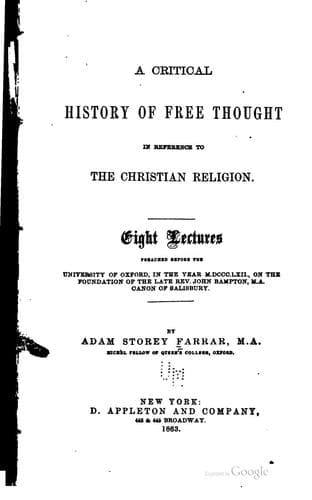
History of Free Thought in Reference to The Christian ReligionFarrar, Adam Storey
History
History of Free Thought in Reference to The Christian Religion
Farrar, Adam Storey
Free thought -- History
Hence, as might be expected, the dogmatic reality of such doctrines as the
Trinity was weakened.(771) The deity of the Son, as distinct from his
superhuman character, became unimportant, save as the historical
embodiment of the ideal union of God with humanity.(772) The Spirit was
viewed, not as a personal agent, but as a living activity, having its seat
in the Christian consciousness of the church.(773) The objective in each
case was absorbed in the spiritual, as formerly in the old rationalism it
had been degraded into the natural. It followed also that the Christian
consciousness, thus able to find as it were a philosophy of religion, and
of the material apprehended by the consciousness of inspired men,
possessed an instinct to distinguish the unimportant from the important in
scripture, and valued more highly the eternal ideas intended than the
historic garb under which they were presented.
The ideological tendency, as it is now called,(774) the natural longing of
the philosophical mind that tries to rise beyond facts into their causes,
to penetrate behind phenomena into ideas, grows up in a country, as is
seen by the example of ancient Greece, when the popular creed and the
scientific have become discordant. Suggested in Germany by the old
rationalism, it had been especially stimulated by the subjective
philosophy of Kant and Fichte. Historic facts were the expression of
subjective forms of thought. The Non-ego was a form, in which the Ego was
expressing itself. This theory, suggested to Schleiermacher from without,
fell in with his own views as above developed, and affected his critical
inquiries. When he involved himself in the great questions of the higher
criticism, which have been already treated in connexion with Semler,
subjective criticism(775) was used in an exaggerated manner, not merely to
suggest hypotheses, or to check deductions by Christian appreciation, but
as a substitute _à priori_ for historic investigation. In the controversy
as to the composition of the Gospels, which will be hereafter explained,
he was led, by his ideological theory and his instinctive perception of
the relative importance of doctrines in theological perspective, to
abandon the historical importance of miracles as compared with doctrine,
and also the verity of the early history of Christ’s life, considered to
have been communicated by tradition; while he held fast to the moral and
historical reality of the latter.(776)
Public-domain text, read in full here on John Shaqi.
Reviews
Reviews
No reviews yet
Be the first to share your thoughts on this work.
Elsewhere in the archive
Join the Discussion
Join the discussion
Sign in to leave a comment or review.
Sign InorCreate an account