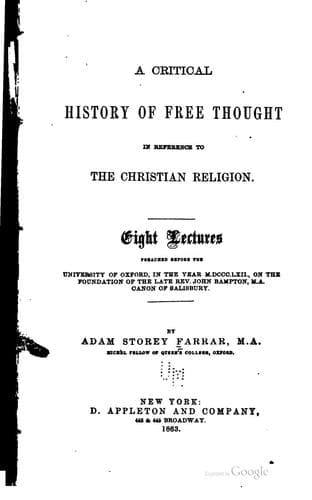
History of Free Thought in Reference to The Christian ReligionFarrar, Adam Storey
History
History of Free Thought in Reference to The Christian Religion
Farrar, Adam Storey
Free thought -- History
These remarks must suffice to point out the position of Schleiermacher. We
have seen how completely he caught the influences of his time, absorbed
them, and transmitted them. If his teaching was defective in its
constructive side; if he did not attain the firm grasp of objective verity
which is implied in perfect doctrinal, not to say critical, orthodoxy; he
at least gave the death-blow to the old rationalism, which, either from an
empirical or a rational point of view, proposed to gain such a philosophy
of religion as reduced it to morality. He rekindled spiritual
apprehensions; he above all drew attention to the peculiar character of
Christianity, as something more than the republication of natural
religion, in the same manner that the Christian consciousness offered
something more than merely moral experience. He set forth, however
imperfectly, the idea of redemption, and the personality of the Redeemer;
and awakened religious aspirations, which led his successors to a deeper
appreciation of the truth as it is in Jesus. Much of his theology, and
some part of his philosophy, had only a temporary interest relatively to
his times; but his influence was perpetual. The faults were those of his
age; the excellencies were his own. Men caught his deep love to a personal
Christ, without imbibing his doctrinal opinions. His own views became more
evangelical as his life went on, and the views of his disciples more
deeply scriptural than those of their master. Thus the light kindled by
him waxed purer and purer. The mantle remained after the prophet’s spirit
had ascended to the God that gave it.
In strict truth he did not found a school. Though his mind was
dialectical, he had too much poetry to do this. Genius, as has been often
observed, does not create a school, but kindles an influence. The
university of Berlin, the very centre of intellectual greatness in every
department from its foundation, was the first seat of Schleiermacher’s
influence; and the political importance of the capital added impulse to
the movement. The reaction extended to other universities,(777) and not
only marked the chief theologians of an orthodox tendency which are
commonly known to us,(778)—Tholuck, Twesten, Nitzch, Julius Müller,
Olshausen,—but even modified the extreme rationalist party, and diffused
its influence among theologians of the church of Rome.(779)
Public-domain text, read in full here on John Shaqi.
Reviews
Reviews
No reviews yet
Be the first to share your thoughts on this work.
Elsewhere in the archive
Join the Discussion
Join the discussion
Sign in to leave a comment or review.
Sign InorCreate an account