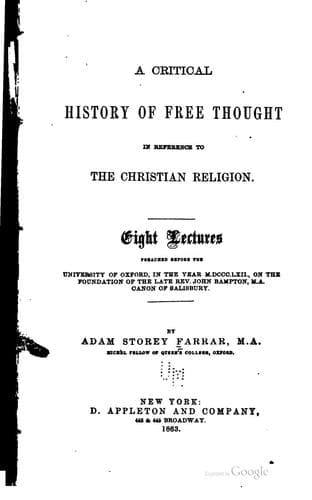
History of Free Thought in Reference to The Christian ReligionFarrar, Adam Storey
History
History of Free Thought in Reference to The Christian Religion
Farrar, Adam Storey
Free thought -- History
It is impossible to specify the views of those who were the chief
representatives of the effects of Schleiermacher’s teaching. One however,
his friend and colleague, deserves mention, the well-known church
historian Neander.(780) Brought up a Jew, he passed into Christianity,
like some of the early fathers, through the gate of Platonism; and,
knowing by experience that free inquiry had been the means of his own
conversion, he ever stood forth with a noble courage as the advocate of
full and fair investigation, feeling confidence that Christianity could
endure the test. More meditative and less dialectical than Schleiermacher,
and too original to be an imitator, he surpassed him in the deeper
appreciation of sin and of redemption; placing sin rather in alienation of
will than in the sense of discordance, and holding more firmly the
existence of some objective reality in the anthropopathic expression of
the wrath of God removed by Christ’s death.(781) His great employment in
life was history; not, like his master, philosophy and criticism. Viewing
human nature from the subjective stand-point, the central thought of his
historical works was, that Christianity is a life resting on a person,
rather than a system resting on a dogma. Hence he was able to find the
harmony of reason and faith from the human side instead of the divine, by
noticing the adaptation of the divine work to human wants. The inspiration
of the scriptural writers was viewed as dynamical not mechanical,
spiritual not literal;(782) and Christianity as the great element of human
progress, being the divine life on earth which God had kindled through the
gift of his Son.(783) The great aim accordingly of Neander in his
historical sketches was to exhibit the Christian church as the philosophy
of history, and God’s work in Christ, realised in the piety of the
faithful, as the philosophy of the Christian church. The history of the
church in his view is the record of the Christian consciousness in the
world. The subjective and mystical spirit engendered by such a conception,
was in danger of converting history into a series of biographies; but the
deep influence which it possessed in contributing to foster the reaction
against the old rationalism will be obvious. It becomes us to speak with
reverence of the writings of a man whose labours have been the means of
turning many to Christ. Though lacking form as works of art, yet, if they
be compared with works of grander type, where church history has been
treated as an epic, we cannot help feeling that the depth of spiritual
perception and of psychological analysis compensates for the artistic
defects. We are conducted by them from the outside to the inside; from
things to thoughts; from institutions to doctrines; from the accidents of
Christianity to the essence.
Public-domain text, read in full here on John Shaqi.
Reviews
Reviews
No reviews yet
Be the first to share your thoughts on this work.
Elsewhere in the archive
Join the Discussion
Join the discussion
Sign in to leave a comment or review.
Sign InorCreate an account