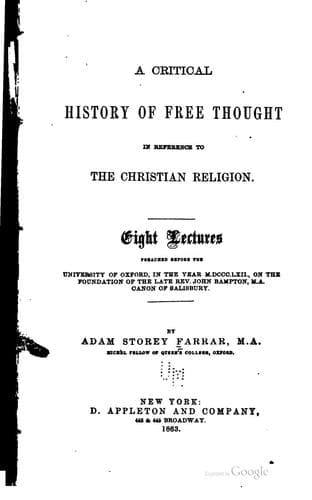
History of Free Thought in Reference to The Christian ReligionFarrar, Adam Storey
History
History of Free Thought in Reference to The Christian Religion
Farrar, Adam Storey
Free thought -- History
Neander’s teaching, while an offshoot from Schleiermacher, marks the
highest point to which the principles of the master could be carried. It
advances farther in the hearty love for Christ and for revelation, and
bears fewer traces of the ancient spirit of rationalism; being allied to
it in few respects, save in the wish constantly exhibited to appropriate
that which is believed; but the wants of the heart, not the conceptions of
the understanding, are made the gauge of divine truth, and the interpreter
of the divine volume.
We pointed out that the great reaction in the present century was marked
not only by the philosophical and doctrinal school just described, but by
a contemporaneous one, which employed itself on literary and critical
inquiries in reference to the Bible, and was the continuation of the
earlier rationalist criticism on improved principles. The most important
name representing this critical movement in the beginning of the period
was De Wette. (32) Perhaps too we may without injustice mention, as a type
of it at the close of the period, a theologian who is almost too original
to admit of being classified—the learned Ewald.
De Wette was nurtured amid the old rationalism of Jena, at the time of its
greatest power, about the beginning of the present century; and imbibed
the peculiar modification of the doctrines of Kant and Jacobi which was
presented in the philosophy of Fries.(784) It was the appeal to subjective
feeling thence derived which preserved him from the coldness of older
critics, and caused his labours to contribute to the reaction. His works
were very various; but the earlier of them were especially devoted to the
examination of the Old Testament, and the later to the New.
The peculiarity of this school generally may be said to be, a disposition
to investigate both Testaments for their own sake as literature, not for
the further purpose of discovering doctrine. These writers are primarily
literary critics, not dogmatic theologians. Like the older rationalists,
they are occupied largely with biblical interpretation; but, perceiving
the hollowness of their attempt to explain away moral and spiritual
mysteries by reference to material events, they transfer to the Bible the
theories used in the contemporary investigations in classical history, and
explain the Biblical wonders by the hypothesis of legends or of myths.
Though they ignore the miraculous and supernatural equally with the older
rationalists, they allow the spiritual in addition to the moral and
natural, and thus take a more scholarlike and elevated view of the Hebrew
history and literature. The system of interpretation adopted is the
transition from the previous one, which admitted the facts but explained
them away, to the succeeding one of Strauss, which denies the facts, and
accounts for the belief in them by psychological causes.
Public-domain text, read in full here on John Shaqi.
Reviews
Reviews
No reviews yet
Be the first to share your thoughts on this work.
Elsewhere in the archive
Join the Discussion
Join the discussion
Sign in to leave a comment or review.
Sign InorCreate an account