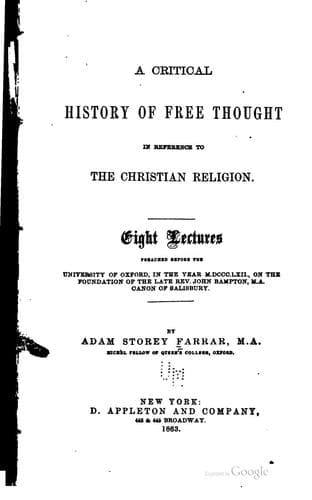
History of Free Thought in Reference to The Christian ReligionFarrar, Adam Storey
History
History of Free Thought in Reference to The Christian Religion
Farrar, Adam Storey
Free thought -- History
The wish to give a possible basis for the existence of legend, by
interposing a chasm between the events and the record of them, stimulated
the pursuit of the branch of criticism slightly touched on by their
predecessors, which investigates the origin and date of scripture books.
They transferred to the Hebrew literature the critical method by which
Wolf had destroyed the unity of Homer, and Niebuhr the credibility of
Livy. Not a single book,—history, poetry, or prophecy,—was left
unexamined. The inquiries of this kind, instituted with reference to the
book of Daniel, were alluded to in a former lecture;(785) and those which
relate to the Gospels will occur hereafter.(786) At present it will only
be possible to specify a single instance in illustration of these
inquiries—the celebrated one which relates to the authorship and
composition of the Pentateuch. It is the one to which most labour has been
devoted, and is an excellent instance for exhibiting the slow but
progressive improvement and growing caution shown in the mode of
exercising them.(787)
As early as the time of Hobbes and Spinoza it was perceived that the
Pentateuch contains a few allusions which seem to have been inserted after
the time of Moses; a circumstance which they, as well as R. Simon,
explained, by referring them to the sacred editor Ezra, who is thought to
have arranged the canon: but about the middle of the last century a French
physician, Astruc,(788) pointed out a circumstance which has introduced an
entirely new element into the discussion of the question; viz. the
distinction in the use of the two Hebrew names for God,—Elohim and
Jehovah. It will be necessary to offer a brief explanation of this
distinction, in order that we may be able to perceive the line at which
fact ends and hypothesis commences, and understand the character of the
criticism which we are describing.
It is now generally admitted that the word _Elohim_ is the name for Deity,
as worshipped by the Hebrew patriarchs; _Jehovah_, the conception of Deity
which is at the root of the Mosaic theocracy.(789) El, or the plural
Elohim, means literally “the powers,” (the plural form being either, as
some unreasonably think, a trace of early polytheism, or more probably
merely emphatic,(790)) and is connected with the name for God commonly
used in the Semitic nations. Jehovah(791) means “self-existent,” and is
the name specially communicated to the Israelites. The idea of power or
superiority in the object of worship was conveyed by Elohim; that of
self-existence, spirituality, by Jehovah. Elohim was generic, and could be
applied to the gods of the heathen; Jehovah was specific, the covenant God
of Moses. (33)
Public-domain text, read in full here on John Shaqi.
Reviews
Reviews
No reviews yet
Be the first to share your thoughts on this work.
Elsewhere in the archive
Join the Discussion
Join the discussion
Sign in to leave a comment or review.
Sign InorCreate an account