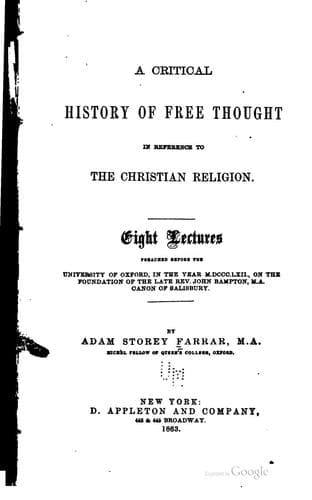
History of Free Thought in Reference to The Christian ReligionFarrar, Adam Storey
History
History of Free Thought in Reference to The Christian Religion
Farrar, Adam Storey
Free thought -- History
In this age, when words are separated from things, we are apt to lose
sight of the importance of the difference of names in an early age of the
world. The modern investigations however of comparative mythology enable
us to realize the fact, that in the childhood of the world words implied
real differences in things; not merely in our conceptions, but in the
thing conceived.(792) But the explanations above offered will show that,
independently of the general law of mind just noticed, a really different
moral conception was offered by Providence to the Hebrew mind through the
employment of these two words.
Nor was the difference unknown or forgotten in later ages of Jewish
history. The fifty-third Psalm, for example, is a repetition of the
fourteenth with the name Elohim altered into Jehovah. In the two first of
the five books into which the Psalms are divided, the arrangement has been
thought to be not unconnected with the distinction of these names.(793) In
the book of Job also the name Jehovah is used in the headings of the
speeches of the dialogues; but in the speeches of Job’s friends, as not
being Israelites, the name Elohim is used.(794) In the book of Nehemiah
the name Elohim is almost always used, and in Ezra, Jehovah; and in the
composition of proper names, which in ancient times were not merely, as
now, symbolical, the names El and Jah respectively are employed in all
ages of the Hebrew nation: and, though no exact law can be detected, it
seems probable that in the great regal and prophetic age the name Jehovah
was especially used. (34)
These remarks will both explain the difference of conception existing in
the Hebrew names of Deity, and show that the Jews were aware of the
distinction to a late period. When we advance farther, we pass from the
region of fact into conjecture.
The distinctness of conception implied in the two names has been made the
basis of an hypothesis, in which they are used for discovering different
elements in the Pentateuch. Throughout the book of Genesis especially, and
slightly elsewhere,(795) the critics that we are describing have supposed
that they detect at least two distinct narratives, with peculiarities of
style, and differences or repetitions of statement; which they have
therefore regarded as proofs of the existence of different documents in
the composition of the Pentateuch; an Elohistic, in which the name Elohim,
and a Jehovistic, in which the name Jehovah was used; upon the respective
dates of which they have formed conjectures.
Though we may object to these hazardous speculations, we shall perceive
the alteration and increasing caution displayed in the criticism, if we
trace briefly the successive opinions held on this particular subject.
Public-domain text, read in full here on John Shaqi.
Reviews
Reviews
No reviews yet
Be the first to share your thoughts on this work.
Elsewhere in the archive
Join the Discussion
Join the discussion
Sign in to leave a comment or review.
Sign InorCreate an account