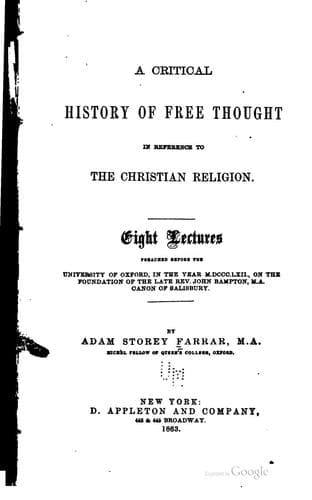
History of Free Thought in Reference to The Christian ReligionFarrar, Adam Storey
History
History of Free Thought in Reference to The Christian Religion
Farrar, Adam Storey
Free thought -- History
Astruc, who first dwelt on the distinction, regarded the separate works to
be anterior to Moses, and to have been used by him in the construction of
the Pentateuch.(796) Eichhorn took the same view, but advanced the inquiry
by a careful discrimination of the peculiarities which he thought to
belong to each. Vater followed, and allowed the possibility of one
collector of the narratives, but denied that it could be Moses. Thus far
was the work of the older critical school of rationalists. It was purely
anatomical and negative. It is at this point that we perceive the
alteration effected by the school which we are now contemplating.
De Wette strove to penetrate more deeply into the question of the origin,
and to attain a positive result. His discussion was marked by minute
study; and he changed the test for distinguishing the documents from the
simple use of the names to more uncertain characteristics, which depended
upon internal peculiarities of style and manner. The conclusion to which
he came was, that the mass of the Pentateuch is based on the Elohistic
document, with passages supplemented from the Jehovistic; and he referred
the age of both to a rather late part of the regal period. Ewald, with
great learning and delicacy of handling, has reconsidered the
question(797) and, though arriving at a most extraordinary theory as to
the manifold documents which have supplied the materials for the work, has
thrown to a much earlier period the authorship of the main portion; and
the views of later critics are gradually tending in the same direction.
Both study the Pentateuch as uninspired literature; but De Wette absurdly
regarded it as an epic created by the priests, in the same manner as the
Homeric epic by the rhapsodes: Ewald on the contrary considers it to be
largely historic.(798)
This statement of mere results, too brief to exhibit the critical acumen
shown at different points of the inquiry even where it is most full of
peril, will show the increasing learning displayed, and the appreciation
of valuable literary characteristics. It will be perceived that
prepossessions still predominate over this criticism; but they are of a
different kind from those which existed earlier. They are not the result
of moral objections to the narratives, but of the contemporary critical
spirit in secular literature. The discrepancy of result obtained by the
process is a fair practical argument which proves its uncertainty; but its
adherents allow that both in art and literature internal evidence admits
of few canons, and consequently that the result of criticism could only
admit of probability.
Public-domain text, read in full here on John Shaqi.
Reviews
Reviews
No reviews yet
Be the first to share your thoughts on this work.
Elsewhere in the archive
Join the Discussion
Join the discussion
Sign in to leave a comment or review.
Sign InorCreate an account