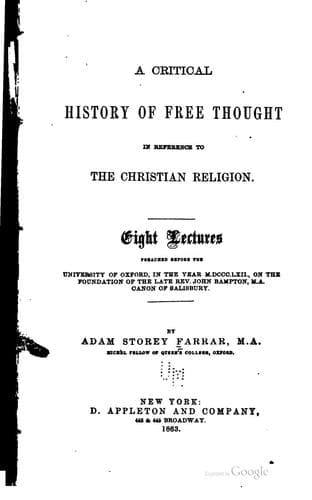
History of Free Thought in Reference to The Christian ReligionFarrar, Adam Storey
History
History of Free Thought in Reference to The Christian Religion
Farrar, Adam Storey
Free thought -- History
The general summary of the movement shows a steady advance in criticism,
as was before shown in doctrine, toward a higher and more spiritual
standard. It is not the recognition of the inspired authority of
scripture, but it is some approach to it. Instead of the hasty
denunciation of narratives or of books as imposture, seen in the
Wolfenbüttel Fragments, or the merely rationalist view of Eichhorn and
Paulus, we perceive the recognition of spiritual and psychological
mysteries as subjects of examination; and even when the result established
is altogether unsatisfactory, valuable materials have been collected for
future students. If we were to abandon our position of traditional
orthodoxy, and accept that of Schleiermacher in doctrine, or of De Wette
in criticism, it would be a retrogression; but for the Germans of their
time it was a progress from doubt towards faith. It was not orthodoxy, but
it was the first approach to it.
This double aspect, philosophical and critical, of the reaction, brings us
to the end of the second period in the history of German theological
thought.
It has already been stated that the elements of other movements existed,
which were hereafter to develope; and that one of these was an attempt,
originating in the philosophy of Hegel, to reconstruct the harmony of
reason and faith from the intellectual, as distinct from the emotional
side. It bore some analogy to the gnosticism of the early church; and the
critical side of it gave birth to Strauss.
We have traced the antecedent causes which produced rationalism, and two
out of the three periods into which we divided the history of it. We are
halting before reaching the final act of the drama; but we already begin
to see the direction in which the plot is developing.
Public-domain text, read in full here on John Shaqi.
Reviews
Reviews
No reviews yet
Be the first to share your thoughts on this work.
Elsewhere in the archive
Join the Discussion
Join the discussion
Sign in to leave a comment or review.
Sign InorCreate an account