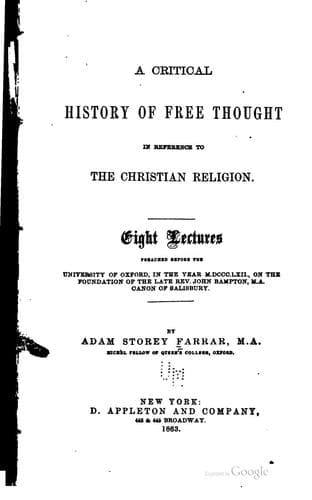
History of Free Thought in Reference to The Christian ReligionFarrar, Adam Storey
History
History of Free Thought in Reference to The Christian Religion
Farrar, Adam Storey
Free thought -- History
It is when a great movement of mind or of society can be thus viewed as a
whole, in its antecedents and its consequents, that we can form a judgment
on its real nature, and estimate its purpose and use. As in viewing works
of art, so in order to observe correctly the great works of God’s natural
providence, we must reduce them to their true perspective. It is the
peculiarity of great movements of mind, that when so viewed they do not
appear to be all shadow and formless, nor acts of meaningless impiety.
They are products of intellectual antecedents, and perform their function
in history. In nothing is the Divine image stamped on humanity, or the
moral providence of God in the world, more visible, than in the
circumstance, of which we have already had frequent proofs, that thought
and honest inquiry, if allowed to act freely, without being repressed by
material or political interference, but checked only by spiritual and
moral influences, gradually attain to truth, appropriating goodness, and
rejecting evil. Thought seems to run on unrestrained, stimulated by human
caprice, sometimes by sinful wilfulness; yet it is seen really to be
restrained by limits that are not of its own creation. In the world of
conscious mind, as in unconscious matter, God hath set a law that shall
not be broken. Reason, which creates the doubts, also allays them. It
rebukes the unbelief of impiety, making the wrath of man to praise God;
and guides the honest inquirer to truth.
A period of doubt is always sad; but it would be an unmixed woe for an
individual or a nation, if it were not made, in the order of a merciful
Providence, the transition to a more deeply-seated faith. It is a means,
not an end.
You tell me, doubt is devil-born.
I know not; one indeed I knew
In many a subtle question versed,
Who touch’d jarring lyre at first,
But ever strove to make it true:
Perplext in faith, but not in deeds,
At last he beat his music out.
There lives more faith in honest doubt,
Believe me, than in half the creeds.
He fought his doubts, and gathered strength,
He would not make his judgment blind,
He faced the spectres of the mind
And laid them: thus he came at length
To find a stronger faith his own.(799)
Religious truth is open to those who will seek it with humility and
prayer.
Public-domain text, read in full here on John Shaqi.
Reviews
Reviews
No reviews yet
Be the first to share your thoughts on this work.
Elsewhere in the archive
Join the Discussion
Join the discussion
Sign in to leave a comment or review.
Sign InorCreate an account