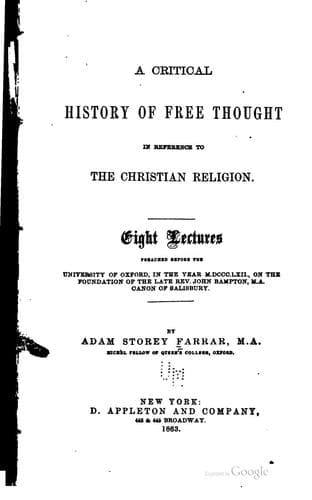
History of Free Thought in Reference to The Christian ReligionFarrar, Adam Storey
History
History of Free Thought in Reference to The Christian Religion
Farrar, Adam Storey
Free thought -- History
In addition to the natural action of reason, the fatherly pity of God is
nigh, to give help to all that ask it, and that endeavour to sanctify
their studies to His honour. Even though the search be long, and a large
portion of life be spent in the agony of baffled effort, the mind reaps
improvement from its heart-sorrows, and at last receives the reward of its
patient faith. “Blessed are they which hunger and thirst after
righteousness, for they shall be filled.”(800) If we are thankful to be
spared the sorrows of the doubter, let us admire the wisdom and mercy
shown in the process by which Providence rescues men or nations from the
state of doubt. “The Lord God omnipotent reigneth;”(801) and He shall
reign for ever and ever.
LECTURE VII. FREE THOUGHT: IN GERMANY SUBSEQUENTLY TO 1835; AND IN FRANCE
DURING THE PRESENT CENTURY.
MATT. xiii. 52.
_Every scribe which is instructed unto the kingdom of heaven is
like unto a man that is an householder, which bringeth forth out
of his treasure things new and old._
The last lecture was brought to a close before we reached the final forms
assumed by German theology. In the present one we must complete the
narrative; and afterwards carry on the history of free thought in France,
as affected by the influence of German literature, from the period at
which the narrative was previously interrupted to the present time.
We have noticed the traces of the reaction in favour of orthodoxy, which
was produced in Germany by the influence of Schleiermacher. We treated the
philosophical side of the movement, the vindication of the distinctness of
religion and ethics; and also witnessed the improved tone in the critical,
tending, if not to the recognition of a supernatural character in the holy
scriptures, yet to a more spiritual appreciation of their literary
characteristics, and of the psychological peculiarity of the facts
recorded. We adverted also, in conclusion, to a rival philosophical
influence, springing from the teaching of Hegel, which assisted the
reaction by seeking a philosophical reconstruction of religion, though
from a different point of view from Schleiermacher.
Public-domain text, read in full here on John Shaqi.
Reviews
Reviews
No reviews yet
Be the first to share your thoughts on this work.
Elsewhere in the archive
Join the Discussion
Join the discussion
Sign in to leave a comment or review.
Sign InorCreate an account