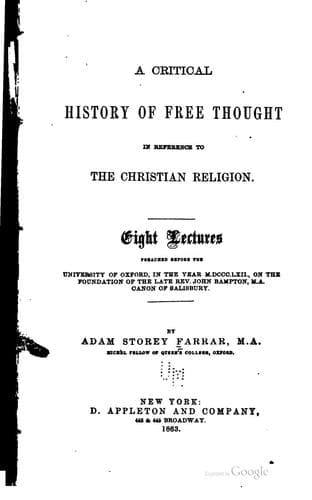
History of Free Thought in Reference to The Christian ReligionFarrar, Adam Storey
History
History of Free Thought in Reference to The Christian Religion
Farrar, Adam Storey
Free thought -- History
The other great problem, the origin of things, and the relation of God to
the world, which is at the basis of religion, as the incarnation is at the
basis of Christianity, has been less frequently handled. Originally
discussed, like the latter, in controversy with the early unbelievers, it
had been touched upon in the speculations of Averroes and Spinoza, in the
materialism of French infidelity, and in the earlier systems of
speculative philosophy in Germany itself. It was this problem which was
attempted by Rothe. (40) Advancing beyond this first question, he has
considered the scheme of Providence in the development of religion, and
the theory of the Christian church in relation to political society. It is
unnecessary here to explain his system: his mind is too original to admit
of comparison without injustice; yet the speculations of our own
Coleridge, who on philosophical principles makes the state to be the
realisation of the church, will perhaps give some imperfect conception of
the character of his attempts.
This second school that we have been considering, though approximating
extremely nearly to orthodoxy, and furnishing the works of most value in
the modern theology, yet seeks to approach religion from the psychological
or philosophical side. It speculates freely, and believes revelation
because it finds it to coincide with the discoveries of free thought. But
there is a third tendency, which believes revelation without professing to
understand it; which rests on the revelation in scripture as an objective
verity, and believes the Bible on the ground of evidence, without
questioning its material.(850)
The first germ of this reaction in favour of rigid orthodoxy was
observable in the feeling aroused by the theses of Harms, in 1817, already
named, on occasion of the celebration of the tricentenary of the
Reformation; but it was quickened by the attempts, initiated by the
Prussian king, between the years 1821 and 1830, to unite the Lutheran and
Calvinistic branches of the Protestant church.(851)
Public-domain text, read in full here on John Shaqi.
Reviews
Reviews
No reviews yet
Be the first to share your thoughts on this work.
Elsewhere in the archive
Join the Discussion
Join the discussion
Sign in to leave a comment or review.
Sign InorCreate an account