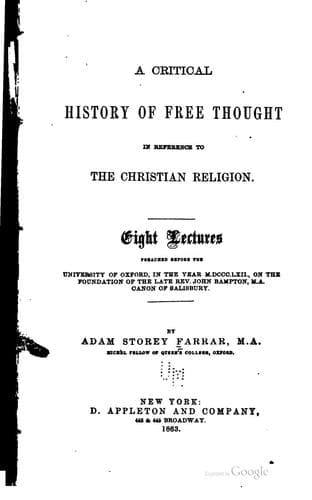
History of Free Thought in Reference to The Christian ReligionFarrar, Adam Storey
History
History of Free Thought in Reference to The Christian Religion
Farrar, Adam Storey
Free thought -- History
The time seemed then to thoughtful men a fitting one, when doctrines were
either regarded as unimportant or superseded by the religious
consciousness, to unite these two churches under the bond of a common
nationality, and the practice of a common liturgy. But the old Lutheran
spirit, which still survived in the retirement of country parishes, was
aroused, and some pastors underwent deprivation and persecution rather
than submit to the union.(852) This new movement at first caught the
spirit of pietism, just as had been the case with that of Schleiermacher;
but gradually abandoned it for a dogmatic and churchlike aspect, as he for
a scientific expression. Its aim was to return to the Lutheranism of the
sixteenth century, and to rally round the confessions of faith of that
period. Hengstenberg(853) at Berlin, and Hävernick,(854) are the names
best known as representing this party at the period of which we speak.
Their efforts were directed to criticism rather than to doctrine, to
reconstruct the basis for Christianity in Judaism by defending the
authenticity and credibility of the ancient scriptures. In doctrine and
the canon, they reverted to the position of the Reformation. But the alarm
ensuing upon the work of Strauss, in 1835, invested this movement with a
more reactionary character; and the journal(855) which gave expression to
Hengstenberg’s views, gradually assumed the character of an ecclesiastical
censorship, frequently marked by defiance and severity, like the tone of
Luther of old.
Public-domain text, read in full here on John Shaqi.
Reviews
Reviews
No reviews yet
Be the first to share your thoughts on this work.
Elsewhere in the archive
Join the Discussion
Join the discussion
Sign in to leave a comment or review.
Sign InorCreate an account