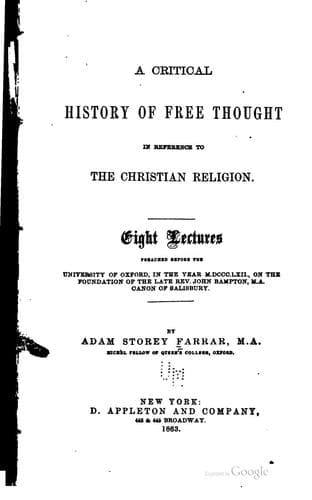
History of Free Thought in Reference to The Christian ReligionFarrar, Adam Storey
History
History of Free Thought in Reference to The Christian Religion
Farrar, Adam Storey
Free thought -- History
Such is the scheme of Comte. The very breadth of it possesses an
attraction; and if viewed merely as a logic of the sciences, it may justly
command attention. Many of the analyses which he supplies of the methods
and history of science are masterly; and his generalisations, even when
hasty, are fertile in suggestion. He was a most original and powerful
thinker; scientific rather than artistic. But his philosophy, viewed as a
whole, is a grand system of materialism which is silent about God, spirit,
personal immortality; diametrically opposed to Christianity, in that it
makes man’s social duty higher than his individual, science the only
revelation, demonstration the only authority, nature’s laws the only
providence, and obedience to them the only piety; and destroys
Christianity by destroying the possibility of its proof. In later life
this distinguished man, feeling the unutterable yearnings of the religious
sentiment, and the necessity that his philosophy should afford
satisfaction to them, invented the system of religion developed in his
catechism;(881) in which, in a manner analogous to that employed by
Feuerbach or St. Simon, he regarded the collective humanity as the true
God, the proper object of worship and reverence; and marked out a church
and a cult, the caricature of the Catholic church, in which the world’s
heroes should receive canonization. The probability of mental derangement
palliates the absurdity of this system in the originator, but throws the
burden of responsibility from the master upon those who are insane enough
to adopt it.
We have traced two of the schools which flourished in the second quarter
of this century. Another remains, which has incurred from opponents the
charge of pantheism, viz. the idealist school, commonly called the
Eclectic; (44) which was especially dominant in France, and in the
university of Paris, during the rule of the Orleans dynasty. Viewed as a
philosophy it is a very noble one. Implying, as its name denotes, an
attempt to reap the harvest of the industry of all preceding schools of
philosophy, it was the chief means of restoring intellectual and spiritual
belief to France, and of creating the great movement of historical study
which marks that period of French literature. Commencing with a reaction
against the materialist and sensationalist school, it sought, by imitating
the mode by which Reid had refuted the philosophical scepticism of Hume,
to find a method for restoring belief in spiritual realities; and
afterwards, when its chief leader Cousin(882) had been exiled to Germany,
he brought back an acquaintance with the successive speculative schools
which existed there.
Public-domain text, read in full here on John Shaqi.
Reviews
Reviews
No reviews yet
Be the first to share your thoughts on this work.
Elsewhere in the archive
Join the Discussion
Join the discussion
Sign in to leave a comment or review.
Sign InorCreate an account