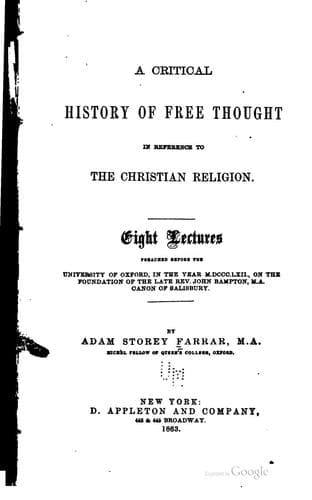
History of Free Thought in Reference to The Christian ReligionFarrar, Adam Storey
History
History of Free Thought in Reference to The Christian Religion
Farrar, Adam Storey
Free thought -- History
The results of the preceding efforts are expressed in him. His system
consisted in a psychological analysis of the human consciousness, which
led him to believe, that spiritual truth is revealed to the reason, or
intuitional and impersonal power, apart from the limitations of sense, or
of the ordinary critical faculties; that the true, the beautiful, and the
good, are perceived by it in their absolute, unlimited essence; and that
the revelation of the infinite is the basis of all intellectual truth, of
all moral obligation, and offers the clue to the criticism of religion,
the solution of the problems of history, and the construction of a
philosophy of the universe. Its chief effect on literature, the permanent
contribution which it has made to human improvement, is to encourage the
historic study of every branch of phenomena, and especially to exemplify
it in the history of thought. Asserting that human society is a gradual
progress of development and of improvement, it regards every age as
manifesting some phase of truth, or of error, and contributing its portion
of knowledge to the student. Humanity is regarded as a divine revelation:
its social and intellectual changes as manifestations of the Eternal.
From this account, brief though it be, the relation will be evident which
such a philosophy and the historic method of eclectic discovery would have
towards religion.
As a system of psychology it is potent, as a means of reasserting the
dignity of human nature against the material and selfish ethics of a
preceding age, and of reconstructing the basis of ethics and natural
religion: but as an ontology, it is in danger of unconscious pantheism; of
identifying God with the universe, and regarding Him merely as a name to
describe a process, instead of a person. As a philosophy of humanity, it
identifies the natural revelation in history with the supernatural; finds
in the psychological faculty of intuition, not merely the basis for, but
the explanation of, the phenomenon of inspiration;(883) and in its view of
religion is essentially antidogmatic, regarding religion as imperfect and
progressive; the idea universal, the symbol transient; and allows the
psychological truthfulness of all creeds; and regards Christianity as only
the most refined species of them, as one of the transient forms that the
religious sentiment has adopted, and as destined to give place to
philosophy; beneficial to humanity, but not constituting it.
This philosophy therefore, though containing so many noble elements, ended
in the view which we have already seen to exist in the Gnostic and German
rationalism, that Christianity was not to be final, the one solitary and
final religious utterance of God to man.(884)
Public-domain text, read in full here on John Shaqi.
Reviews
Reviews
No reviews yet
Be the first to share your thoughts on this work.
Elsewhere in the archive
Join the Discussion
Join the discussion
Sign in to leave a comment or review.
Sign InorCreate an account