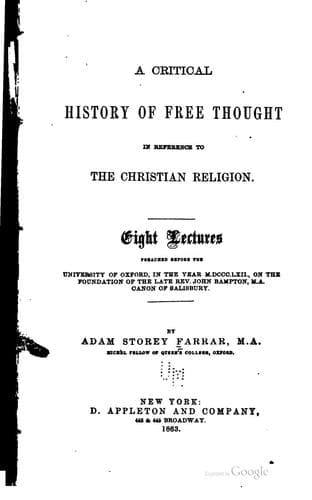
History of Free Thought in Reference to The Christian ReligionFarrar, Adam Storey
History
History of Free Thought in Reference to The Christian Religion
Farrar, Adam Storey
Free thought -- History
The three schools illustrate the principal tendencies in which unbelief
manifested itself in France previous to the establishment of the
empire;(885) and show clearly the intimate relation of particular kinds of
sceptical views to particular systems of metaphysical philosophy.(886)
In the latter years of Napoleon I. the struggle first commenced between
the Voltairian party and the church; a middle course being taken by the
eclectics. The constitutional tendency of this last school gave them the
moral victory during the restoration, over the democratic tendency of the
one and the reactionist of the other. After the revolution of 1830, the
socialist struggle was superadded; which, when mixed with the old
ideology, produced Positivism.
The catholic church had sought to restore faith in Christianity, partly by
the establishment of _Conférences_,(887) lectures to reply to the systems
now described; and partly by trying to satisfy the reason by establishing
a rival philosophy, and stating philosophically the grounds of faith. (45)
This philosophy, though noble in its aim, and taught by many pious minds,
is visionary. It was based on the principle first evolved by Huet; the
weakness of human reason, and the supposed necessity of submission to
authority. In De Maistre, its founder, who carried out in philosophy what
Chateaubriand did in literature, it was the suggestion of an abject
submission to the papacy, as the living authority on earth; accompanied by
a sceptical disbelief of the value of inductive science. It has expressed
itself in different forms; but in all it has been an attempt to find a
solution for difficulties by means of religion instead of philosophy; an
attempt analogous to that in other lands, not merely to restrain the human
reason in matters of religion, but to inculcate distrust of it; falling
into the very error which Plato made his master describe, of those who,
baffled in the search for truth, blame not their own unskilfulness, but
reason itself; and pass the rest of their lives in contempt of it; and
thus are deprived of the knowledge that they seek.
The history of thought in France, thus studied, exhibits a general
resemblance to that of Germany in its forms and tendency. In both alike
there has been a contest, between the school which seeks to absorb
Christianity in philosophy, and that which extinguishes philosophy by
Christianity. There is an absence indeed in France of the spiritual return
to a living Christian faith, the union of science and piety, which is
observable in the latter country. But within the sphere of natural
religion, in reference to the belief in a spiritual world, an advance is
perceptible, if the present condition of France be measured against that
which was observable at the period when the philosophic unbelief of the
last century predominated.
Public-domain text, read in full here on John Shaqi.
Reviews
Reviews
No reviews yet
Be the first to share your thoughts on this work.
Elsewhere in the archive
Join the Discussion
Join the discussion
Sign in to leave a comment or review.
Sign InorCreate an account