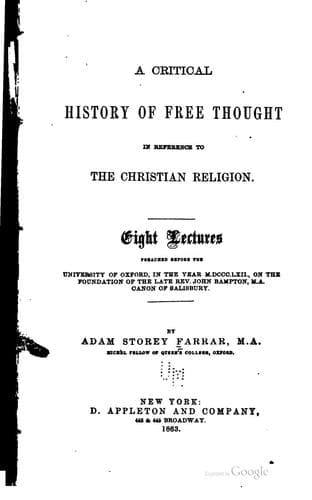
History of Free Thought in Reference to The Christian ReligionFarrar, Adam Storey
History
History of Free Thought in Reference to The Christian Religion
Farrar, Adam Storey
Free thought -- History
(2) Morally, in creating deep pity for the sinner, united with hatred for
the sin. (p. 36.)
Concluding remarks on the spirit which has influenced the writer in these
lectures. (pp. 37, 38.)
Lecture II.
_The literary opposition of Heathens against Christianity in the early
ages._
_The first of the four crises of the faith._ (pp. 39-74.) Agreement and
difference of this crisis with the modern. (p. 40.) Sources for
ascertaining its nature, the original writings of unbelievers being lost.
(pp. 41, 42.)
Preliminary explanation of four states of belief among the heathens in
reference to religion, from which opposition to Christianity would arise:
(pp. 43-118) viz.
(1) the tendency to absolute disbelief of religion, as seen in Lucian and
the Epicurean school. (p. 43.) (2) a reactionary attachment to the
national creed,—the effect of prejudice in the lower orders, and of policy
in the educated. (pp. 45, 46.) (3) the philosophical tendency, in the
Stoics, (p. 44) and Neo-Platonists. (pp. 45, 46.) (4) the mystic
inclination for magic rites. (p. 47.)
Detailed critical history of the successive literary attacks on
Christianity. (p. 48 seq.)
1. that of Lucian, about A.D. 170, in the _Peregrinus Proteus_. (pp.
48-50.) 2. that of Celsus, about the same date. (pp. 50-55.) 3. that of
Porphyry, about 270. (pp. 56-61.) 4. that of Hierocles about 303, founded
on the earlier work of Philostratus respecting the life of Apollonius of
Tyana. (pp. 62-64.) 5. that of Julian, A.D. 363; an example of the
struggle in deeds as well as in ideas. (pp. 65-68.)
(Account of the _Philopatris_ of the Pseudo-Lucian. (p. 67.))
Conclusion; showing the relation of these attacks to the intellectual
tendencies before mentioned (p. 69), and to the general intellectual
causes sketched in Lect. I. (p. 69.)—Insufficiency of these causes to
explain the whole phenomenon of unbelief, unless the conjoint action of
emotional causes be supposed. (pp. 71, 72.)
Analogy of this early conflict to the modern. Lessons from consideration
of the means by which the early Church repelled it. (pp. 72-74.)
Lecture III.
_Free Thought during the middle ages, and at the Renaissance; together
with its rise in modern times._
This period embraces the second and third of the four epochs of doubt, and
the commencement of the fourth. Brief outline of the events which it
includes. (pp. 75, 76.)
_Second crisis_, from A.D. 1100-1400. (pp. 76-92.) It is a struggle
political as well as intellectual, Ghibellinism as well as scepticism. (p.
76.)
The intellectual tendencies in this period are four:
Public-domain text, read in full here on John Shaqi.
Reviews
Reviews
No reviews yet
Be the first to share your thoughts on this work.
Join the Discussion
Join the discussion
Sign in to leave a comment or review.
Sign InorCreate an account