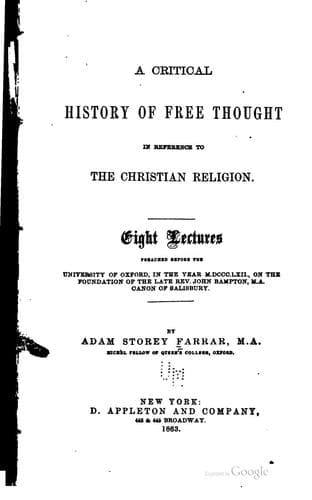
History of Free Thought in Reference to The Christian ReligionFarrar, Adam Storey
History
History of Free Thought in Reference to The Christian Religion
Farrar, Adam Storey
Free thought -- History
1. The scepticism developed in the scholastic philosophy, as seen in the
Nominalism of Abélard in the twelfth century. Account of the scholastic
philosophy, pp. 77-80; and of Abélard as a sceptic in his treatise _Sic et
Non._ (pp. 81-85.) 2. The _mot_ of progress in religion in the Franciscan
book called _The Everlasting Gospel_ in the thirteenth century. (pp. 86,
87.) 3. The idea of the comparative study of religion, as seen in the
legend of the book _De Tribus Impostoribus_ in the thirteenth century; and
in the poetry of the period. (pp. 88, 89.) 4. The influence of the
Mahometan philosophy of Averroes in creating a pantheistic disbelief of
immortality. (pp. 90, 91.)
Remarks on the mode used to oppose these movements; and critical estimate
of the period. (pp. 91, 92.)
_Third crisis_, from 1400-1625. (pp. 93-105.) Peculiarity of this period
as the era of the Renaissance and of “Humanism,” and as the transition
from mediæval society to modern. (p. 93.)
Two chief sceptical tendencies in it:
(1) The literary tendency in Tuscany and Rome in the fifteenth century;
the dissolution of faith being indicated by (a) the poetry of the romantic
epic. (p. 94.) (b) the revival of heathen tastes. (p. 95.)
Estimate of the political and social causes likely to generate doubt,
which were then acting. (pp. 97, 98.) the unbelief was confined to
Italy.—Reasons why so vast a movement as the Reformation passed without
fostering unbelief. (p. 99.)
2. The philosophical tendency in the university of Padua in the sixteenth
century. (p. 99 seq.) The spirit of it, pantheism (p. 100), in two forms;
one arising from the doctrines of Averroes; the other seen in Pomponatius,
from Alexander of Aphrodisias. (p. 101.) The relation of other
philosophers, such as Bruno and Vanini, to this twofold tendency. (pp.
102-104.)
Remarks on the mode used to oppose doubt (p. 104); and estimate of the
crisis. (p. 105.)
_Fourth crisis_; (pp. 105-339) commencing in the seventeenth century,
through the effects of the philosophy of Bacon and Descartes. (p. 106.)
The remainder of the lecture is occupied with the treatment of the
influence of Cartesianism, as seen in Spinoza.
Examination of Spinoza’s philosophy (pp. 106-110); of his criticism in the
_Theologico-Politicus_ (pp. 109-113); and of his indirect influence. (p.
113, 114.)
Concluding remarks on the government of Providence, as witnessed in the
history of large periods of time, such as that comprised in this lecture.
(p. 115.)
Lecture IV.
_Deism in England previous to A.D. 1760._
This lecture contains the first of the three forms which doubt has taken
in the fourth crisis. (p. 116.)—Sketch of the chief events, political and
intellectual, which influenced the mind of England during the seventeenth
century (p. 117); especial mention of the systems of Bacon and Descartes,
as exhibiting the peculiarity that they were philosophies of method. (pp.
117, 118.)
The history of Deism studied:
Public-domain text, read in full here on John Shaqi.
Reviews
Reviews
No reviews yet
Be the first to share your thoughts on this work.
Join the Discussion
Join the discussion
Sign in to leave a comment or review.
Sign InorCreate an account