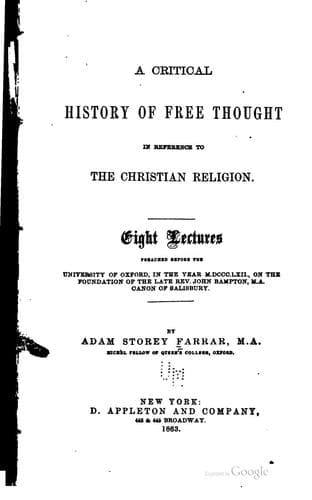
History of Free Thought in Reference to The Christian ReligionFarrar, Adam Storey
History
History of Free Thought in Reference to The Christian Religion
Farrar, Adam Storey
Free thought -- History
Such examples, indeed, are not restricted to Christian history, but are
general facts of the history of the human mind. The fifth century B.C. was
such an epoch in Greece;(1020) when various causes, social and
intellectual, created a sudden awakening of the human mind to reconsider
its old beliefs, and find a home for the new views of nature and of the
world which were opening. The free thought of the Sophists was the
scepticism of doubt, of distrust; the proposal to surrender, to destroy
the old: the free thought of Socrates was the scepticism of inquiry, the
attempt to reconsider first principles, to rebuild truth anew. In all such
moments, investigation is indirectly the means of stimulating knowledge.
The history of the progress of it, in reference to the difficulties which
have beset the Christian church, shows us that the epochs of doubt have
not generally been produced by unbelief taking the initiative in attacking
old truths without some fresh stimulus, and repeating old objections so as
to exhibit perpetually recurring cycles of unbelief. We have rather seen
that doubt is reawakened by the introduction of new forms of knowledge;
and though old doubts recur, yet that they come arrayed in a new garb,
suggested by different motives, deduced from fresh premises, and
accompanied by doubts of a new kind before unknown. In a practical point
of view, frequently they may be thought not to differ widely in appearance
from old ones, and to present similar effects as well as forms; but in a
scientific one, they ought not to be confounded, inasmuch as they do not
present identity of cause. There has been a slow but real progress in
knowledge, and a slow but real change in the modes of applying it to
Christian religion. The effect of the defence offered for Christianity is
equally powerful in leaving its impress on subsequent doubt, as the
progress of knowledge is in suggesting novelty of form. The sphere is
narrowed, or the direction changed. If thought seems to have come round in
its revolution to the same spot in its orbit, it will be found to be
moving not on a circle, but on a spiral; slowly but surely approaching a
little nearer to the great central truth, toward which it is unconsciously
attracted.
Public-domain text, read in full here on John Shaqi.
Reviews
Reviews
No reviews yet
Be the first to share your thoughts on this work.
Elsewhere in the archive
Join the Discussion
Join the discussion
Sign in to leave a comment or review.
Sign InorCreate an account