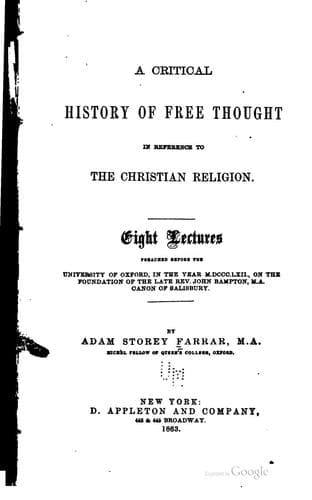
History of Free Thought in Reference to The Christian ReligionFarrar, Adam Storey
History
History of Free Thought in Reference to The Christian Religion
Farrar, Adam Storey
Free thought -- History
In the earliest age of the church, previous to the establishment of
Christianity as the state religion, we observe the unaided appeal to
argument, and especially the abundant use made of the internal evidence,
or philosophical argument concerning the excellence of Christianity, as a
means for arresting attention, preparatory to the presentation of the
external and historic proof.(1029) In the long interval of the middle
ages, the church was able to supplement or supersede argument by force;
yet it must be admitted that the political and intellectual condition of
the European mind was then, to a large extent, such as to receive benefit
from the imposition of an external rule of religious authority and
doctrine, in the same manner that individuals, when in a state of
childhood, need a rule, not a principle; a law, not a reason.(1030) This
method however was unsuited when the mind of Europe awoke, and when free
thought could no longer be suppressed by force.
The history of evidences since the spread of modern unbelief exhibits not
only the return to the ancient Christian weapon of argument instead of
force; but not unfrequently to the ancient mode of presenting the
philosophical proof prior to the historical.
An attempt of this kind was intermingled with the English school of
evidences of the last century; and the argument of analogy used by Butler,
if viewed as constructive, and not refutative, may be considered to have
for its object to prepare the mind for accepting revealed religion, by
first showing the probability of it on the ground of its similarity to
nature. (48) And in the German movement, where the doubt thrown by
criticism over the historical evidences even still more compelled the
resort to the philosophical argument on the part of those who strove to
defend the faith, we have seen various attempts to reconstruct
Christianity from the philosophical side.(1031) Both methods, the
philosophical and the historical, have had their place; but their use has
varied with the wants of the age. In proportion as the pressure of doubt
left less opportunity for the constraining force of the latter, the
persuasiveness of the _à priori_ moral argument has been used.
The history of the means which have been successful in removing doubts
lends little support to the opinion which would save the faith by the
sacrifice of the reason, or would imperil the truth of religion by
throwing discredit on the immutability of moral distinctions, perceived by
the conscience which Providence has placed in the human mind; to which the
great writers on evidence have been wont to make their appeal; and which
they have justly perceived must lie at the basis of the evidences
themselves. “If the light that is in thee be darkness, how great is that
darkness!”
Public-domain text, read in full here on John Shaqi.
Reviews
Reviews
No reviews yet
Be the first to share your thoughts on this work.
Elsewhere in the archive