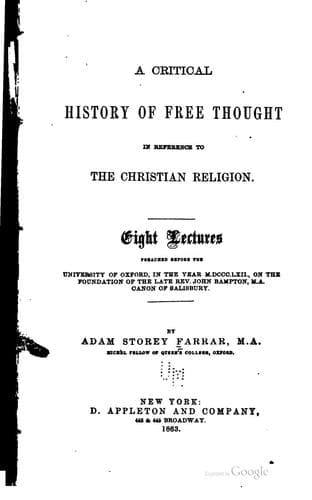
History of Free Thought in Reference to The Christian ReligionFarrar, Adam Storey
History
History of Free Thought in Reference to The Christian Religion
Farrar, Adam Storey
Free thought -- History
This inquiry would complete the study of history as a science. But when we
deal with moral as distinct from material relations, we feel that there is
a question of philosophy as well as science, one of ethics and
metaphysics, which rises above all lower ones. We instinctively wish to
measure the responsibility of the moral agents who have contributed to
work out the results which have been studied. We turn to the personal and
biographical question for the purpose of the ethical lesson. The theist
also asks another question. Believing that nature and man are the work,
direct or indirect, of a personal Creator and Governor, of infinite power
and goodness, he strives to search out the purposes of Providence, hoping
to find in the drama of universal history the solution of the plot which
he could not expect to attain by the study of a portion of it.
Such are the ideas which are intended in the text.
Note 2. p. 4. The Comparative Study Of Religions.
The comparison of Christianity with other religions was necessarily forced
upon the Christian church by contact with the heathen world.
We meet in the early fathers with two distinct opinions; the one held in
the Alexandrian school, that the heathen religions were imperfect but had
a germ of truth, and that philosophy was a schoolmaster to bring men to
Christ; the other chiefly in the African school, that they were entire
errors, and an obstacle to the conversion of mankind.
In the middle ages, contact with Mahometan life (see Lect. III. p. 88)
created a sceptical mode of comparing Christianity with other creeds;
circumstances compelling toleration, and toleration passing into
indifference. A similar spirit is also seen in the hasty attempt of the
French philosophers of the last century to resolve all religion into
priestcraft.
It is only in still more recent times that the first scientific conception
of a comparative study of religion arose. Even in Herder the comparison is
æsthetical more than scientific, and relates to the comparison of
literatures more than of religious ideas. Benjamin Constant (_De la
Religion Considérée dans sa source, ses formes et ses développements_,
1824) seems to have been the first who really suggested a serious
psychological examination; and hence there soon arose the idea of
comparative theology analogous to comparative anatomy. His spirit has
pervaded French literature subsequently. The religious speculations of the
eclectic school give expression to it; e.g. Quinet (_Le Génie des
Religions_, vol. i.); and the mode of contemplating religion in Renan
(_Etudes de l’Histoire Religieuse_) is based upon it. Caution in using the
method is necessary on the part of those who believe in the unique and
miraculous character of the Jewish and Christian revelations. In Lect.
III. (p. 87) we have given an enumeration of three modes; the one true,
the others false; in which Christianity may be put into comparison with
other creeds.
Public-domain text, read in full here on John Shaqi.
Reviews
Reviews
No reviews yet
Be the first to share your thoughts on this work.
Elsewhere in the archive
Join the Discussion
Join the discussion
Sign in to leave a comment or review.
Sign InorCreate an account