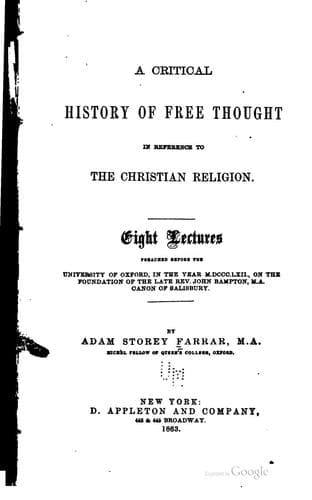
History of Free Thought in Reference to The Christian ReligionFarrar, Adam Storey
History
History of Free Thought in Reference to The Christian Religion
Farrar, Adam Storey
Free thought -- History
2. The Sanskrit literature has been the subject of still more careful
study by a series of learned men. See Donaldson’s _Cratylus_, b. i. ch.
ii. § 36. 3d ed. Nearly the whole of the literature indirectly offers
materials for a history of the alteration and deterioration of religious
and ethical ideas, and of the relation of schools of philosophy to a
national creed preserved by the priesthood and deposited in books esteemed
sacred. The literary works can be placed in their relative order, though
the absence of all chronological dates from the time of the contact of the
Indians with the Greeks (third century B.C.), down to the visits of the
Chinese Buddhist pilgrims in the fourth and seventh centuries A.D., whose
works have been translated into French by A. Remusat and Stanislas
Julien,(1055) and the Mahometan histories, renders the determination of
absolute dates impossible. The following are the dates approximately given
for the chief works of Sanskrit literature. The _Vedas_, especially the
oldest, date from B.C. 1200 to 600. The _Epic Poems_, the _Rámáyana_ and
_Mahábhárata_, are perhaps of the third century B.C.; the laws of _Manu_,
or more truly of the family which claimed descent from the mythical
_Manu_, contain materials dating from several centuries B.C., but were put
into their present form probably several centuries A.D.; the _Bhagavat
Gitá_, an episode in the _Mahábhárata_ bearing traces of a Christian
influence, dates some centuries A.D. The Hindu drama is perhaps subsequent
to 500 A.D. The _Puránas_ carry on the literature to mediæval times.
Several of the systems of philosophy were probably constructed anterior to
the Christian era; but the date at which they were put into their present
form is undetermined.
The earlier literature is regarded as the most valuable for the study of
the growth of religious ideas and institutions. The development or
deterioration may be traced from the simple nature-worship of the _Vedas_,
to the accumulation of legends which disgrace the modern creed. The causes
which gave birth to mythology are no longer a matter of conjecture; the
study of the Sanskrit language and literature having exhibited an
historical instance of it. In this way the early Sanskrit literature
becomes one of the most precious treasures to the mental philosopher who
approaches his subject from the historical side.
Public-domain text, read in full here on John Shaqi.
Reviews
Reviews
No reviews yet
Be the first to share your thoughts on this work.
Elsewhere in the archive
Join the Discussion
Join the discussion
Sign in to leave a comment or review.
Sign InorCreate an account