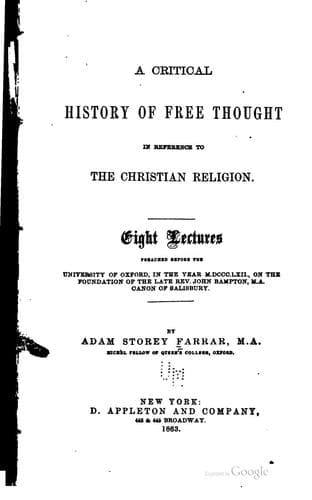
History of Free Thought in Reference to The Christian ReligionFarrar, Adam Storey
History
History of Free Thought in Reference to The Christian Religion
Farrar, Adam Storey
Free thought -- History
The word “free thought” is now commonly used, at least in foreign
literature(6), to express the result of the revolt of the mind against the
pressure of external authority in any department of life or speculation.
Information concerning the history of the term is given elsewhere.(7) It
will be sufficient now to state, that the cognate term, _free thinking_,
was appropriated by Collins early in the last century(8) to express Deism.
It differs from the modern term _free thought_, both in being restricted
to religion, and in conveying the idea rather of the method than of its
result, the freedom of the mode of inquiry rather than the character of
the conclusions attained; but the same fundamental idea of independence
and freedom from authority is implied in the modern term.
Within the sphere of its application to the Christian religion, free
thought is generally used to denote three different systems; viz.
Protestantism, scepticism, and unbelief. Its application to the first of
these is unfair.(9) It is true that all three agree in resisting the
dogmatism of any earthly authority; but Protestantism reposes implicitly
on what it believes to be the divine authority of the inspired writers of
the books of holy scripture; whereas the other two forms acknowledge no
authority external to the mind, no communication superior to reason and
science. Thus, though Protestantism by its attitude of independence seems
similar to the other two systems, it is really separated by a difference
of kind, and not merely of degree.(10) The present history is restricted
accordingly to the treatment of the two latter species of free
thought,—the resistance of the human mind to the Christian religion as
communicated through revelation, either in part or in whole, neither the
scepticism which disintegrates it, or the unbelief which rejects it: the
former directing itself especially against Christianity, the latter
against the idea of revelation, or even of the supernatural generally.
An analogous reason to that which excludes the history of Protestantism,
excludes also that of the opposition made to Christianity by heresy, and
by rival religions:(11) inasmuch as they repose on authorities, however
false, and do not profess to resort to an unassisted study of nature and
truth.
This account of the province included under free thought will prepare the
way for the explanation of the mode in which the subject is treated.
Public-domain text, read in full here on John Shaqi.
Reviews
Reviews
No reviews yet
Be the first to share your thoughts on this work.
Join the Discussion
Join the discussion
Sign in to leave a comment or review.
Sign InorCreate an account