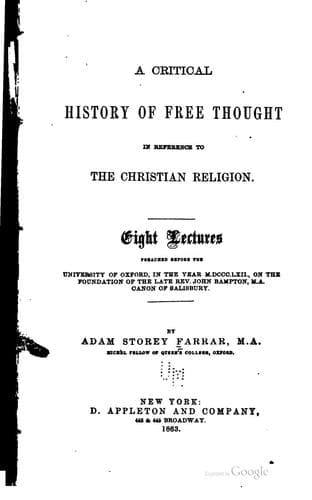
History of Free Thought in Reference to The Christian ReligionFarrar, Adam Storey
History
History of Free Thought in Reference to The Christian Religion
Farrar, Adam Storey
Free thought -- History
It is clear that the history, in order to rise above a chronicle, must
inquire into the causes which have made freedom of inquiry develop into
unbelief. The causes have usually been regarded by theologians to be of
two kinds, viz. either superhuman or human; and, if of the latter kind, to
be either moral or intellectual. Bishop Van Mildert, in his History of
Infidelity, restricted himself entirely to the former.(12) Holding
strongly that the existence of evil in the world was attributable, not
only indirectly and originally, but directly and perpetually, to the
operation of the evil spirit, he regarded every form of heresy and
unbelief to be the attempt of an invisible evil agent to thwart the truth
of God; and viewed the history of infidelity as the study of the results
of the operation of this cause in destroying the kingdom of righteousness.
Such a view invests human life and history with a very solemn character,
and is not without practical value; but it will be obvious that an
analysis of this kind must be strictly theological, and removes the
inquiry from the province of human science. Even when completed, it leaves
unexplored the whole field in which such an evil principle operates, and
the agencies which he employs as his instruments.
The majority of writers on unbelief accordingly have treated the subject
from a less elevated point of view, and have limited their inquiry to the
sphere of the operation of human causes, the _media axiomata_ as it
were,(13) which express the motives and agencies which have been
manifested on the theatre of the world, and visible in actual history. It
will be clear that within this sphere the causes are specially of two
kinds; viz. those which have their source in the will, and arise from the
antagonism of feeling, which wishes revelation untrue, and those which
manifest themselves in the intellect, and are exhibited under the form of
difficulties which beset the mind, or doubts which mislead it, in respect
to the evidence on which revelation reposes. The former, it may be feared,
are generally the ground of unbelief; the latter the basis of doubt.
Christian writers, in the wish to refer unbelief to the source of
efficient causation in the human will, with a view of enforcing on the
doubter the moral lesson of responsibility, have generally restricted
themselves to the former of these two classes; and by doing so have
omitted to explore the interesting field of inquiry presented in the
natural history of the variety of forms assumed by scepticism, and their
relation to the general causes which have operated in particular ages:—a
subject most important, if the intellectual antecedents thus discovered be
regarded as causes of doubt; and not less interesting, if, instead of
being causes, they are merely considered to be instruments and conditions
made use of by the emotional powers.
Public-domain text, read in full here on John Shaqi.
Reviews
Reviews
No reviews yet
Be the first to share your thoughts on this work.
Join the Discussion
Join the discussion
Sign in to leave a comment or review.
Sign InorCreate an account