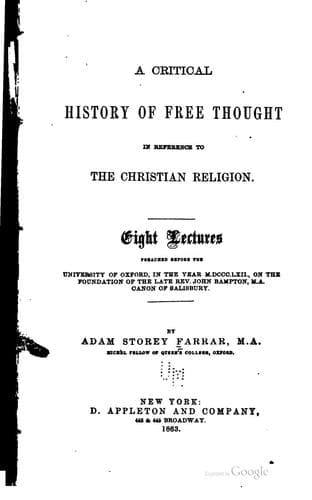
History of Free Thought in Reference to The Christian ReligionFarrar, Adam Storey
History
History of Free Thought in Reference to The Christian Religion
Farrar, Adam Storey
Free thought -- History
Statement of the modes of viewing the question in different ages. (p.
373.)
The Bible an authority; but the importance shown of using wisdom in not
pressing the difficulties of scripture on an inquirer, so as to quench
incipient faith. (p. 374.)
The mention of the emotional causes of doubt conjoined with the
intellectual, a warning that, in addition to all arguments, the help of
the divine Spirit to hallow the emotions must be sought and expected. (p.
375.)
Final lesson to Christian students, that in all ages of peril, earnest men
have found the truth by the method of study united to prayer. (pp.
376-379.)
LECTURE I. ON THE SUBJECT, METHOD, AND PURPOSE OF THE COURSE OF LECTURES.
LUKE vii. 51.
_Suppose ye that I am come to give peace on earth? I tell you,
nay; but rather division._
The present course of lectures relates to one of the conflicts exhibited
in the history of the Church; viz. the struggle of the human spirit to
free itself from the authority of the Christian faith.
Christianity offers occasion for opposition by its inherent claims,
independently of accidental causes. For it asserts authority over
religious belief in virtue of being a supernatural communication from God,
and claims the right to control human thought in virtue of possessing
sacred books which are at once the record and the instrument of this
communication, written by men endowed with supernatural inspiration. The
inspiration of the writers is transferred to the books, the matter of
which, so far as it forms the subject of the revelation, is received as
true because divine, not merely regarded as divine because perceived to be
true. The religion, together with the series of revelations of which it is
the consummation, differs in kind from ethnic religions, and from human
philosophy; and the sacred literature differs in kind from other books.
Each is unique, a solitary miracle of its class in human history.
The contents also of the sacred books bring them into contact with the
efforts of speculative thought. Though at first glance they might seem to
belong to a different sphere, that of the soul rather than the intellect,
and to possess a different function, explaining duties rather than
discovering truth; yet in deep problems of physical or moral history, such
as Providence, Sin, Reconciliation, they supply materials for limiting
belief in the very class of subjects which is embraced in the compass of
human philosophy.
A conflict accordingly might naturally be anticipated, between the
reasoning faculties of man and a religion which claims the right on
superhuman authority to impose limits on the field or manner of their
exercise; the intensity of which at various epochs would depend, partly
upon the amount of critical activity, and partly on the presence of causes
which might create a divergence between the current ideas and those
supplied by the sacred literature.
Public-domain text, read in full here on John Shaqi.
Reviews
Reviews
No reviews yet
Be the first to share your thoughts on this work.
Join the Discussion
Join the discussion
Sign in to leave a comment or review.
Sign InorCreate an account