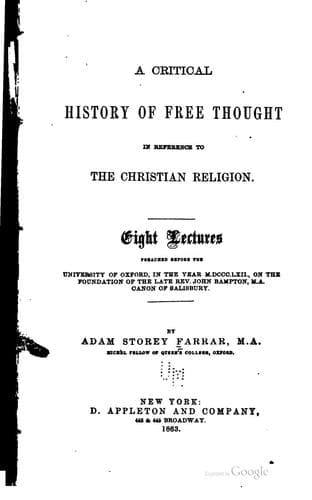
History of Free Thought in Reference to The Christian ReligionFarrar, Adam Storey
History
History of Free Thought in Reference to The Christian Religion
Farrar, Adam Storey
Free thought -- History
The probability shown from consideration of the state of the various
sciences, mechanical, physiological (p. 355), and mental (p. 355), that no
new difficulties can be suggested hereafter, distinct in _kind_ from the
present; nor any unknown kinds of evidence presented on behalf of
Christianity.
Analogy of the present age as a whole, in disintegration of belief, to the
declining age of Roman civilization. (p. 356.)
The doubts which beset us in the present age stated to be chiefly three
(p. 357), viz.:
1. The relation of the natural to the supernatural. This doubt is
sometimes expressed in a spirit of utter unbelief; sometimes in a tone of
sadness (p. 358), arising from mental struggles, of which some are
enumerated (p. 358). The intellectual and moral means of meeting these
doubts. (p. 359.)
2. The relation of the atoning work of Christ to the human race. (p. 360.)
Explanation of the defective view which would regard it only as
reconciling man to God, and would destroy the priestly work of Christ; and
statement of the modes in which its advocates reconcile it with
Christianity. (p. 361.)
The importance that such doubts be answered by reason, not merely silenced
by force. (p. 362.)
An answer sought by studying the various modes used in other ages of the
church (p. 362); especially by those who have had to encounter the like
difficulties, e.g. the Alexandrian fathers in the third century, and the
faithful in Germany in the present. (p. 363.)
This method shown to have been to present the philosophical prior to the
historical evidence, in order to create the sense of religious want,
before exhibiting Christianity as the divine supply for it. (p. 364.)
In regard to the historic evidence, three misgivings of the doubter
require to be met for his full satisfaction (p. 366); viz.
(α) The literary question of the trustworthiness of the books of the New
Testament.
The mode of meeting this explained, with the possibility of establishing
Christian dogmas, even if the most extravagant rationalism were for
argument’s sake conceded. (p. 367.)
(β) The doubt whether the Christian dogmas, and especially the atonement,
are really taught in the New Testament. The value of the fathers, and the
progress of the doctrine in church history, shown in reference to this
question. (p. 368.)
(γ) The final difficulty which the doubter may put, whether even apostolic
and miraculous teaching is to overrule the moral sense. (p. 369.)
The possibility shown of independent corroboration of the apostolic
teaching, in the testimony of the living church, and the experience of
religious men. (p. 371.)
The utter improbability of error in this part of scriptural teaching, even
if the existence of error elsewhere were for argument’s sake conceded. (p.
370.)
Difference of this appeal from that of Schleiermacher to the Christian
consciousness.
3. The relation of the Bible to the church, whether it is a record or an
authority. (p. 372.)
Public-domain text, read in full here on John Shaqi.
Reviews
Reviews
No reviews yet
Be the first to share your thoughts on this work.
Join the Discussion
Join the discussion
Sign in to leave a comment or review.
Sign InorCreate an account