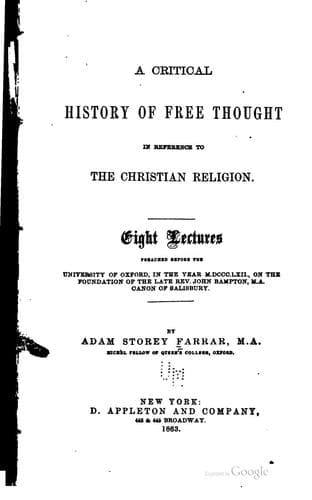
History of Free Thought in Reference to The Christian ReligionFarrar, Adam Storey
History
History of Free Thought in Reference to The Christian Religion
Farrar, Adam Storey
Free thought -- History
The chief portion of the present lecture will be devoted to explain the
mode of applying the plan just indicated; more especially to develop the
second of these three branches, by stating the law which has marked the
struggle of free thought with Christianity, and illustrating the
intellectual causes which have been manifested in it.
In searching for such a law, or such causes, we ought not to forget that,
if we wished to lay a sound basis for generalization, it would be
necessary not to restrict our attention to the history of Christianity,
but to institute a comparative study of religions, ethnic or revealed, in
order to trace the action of reason in the collective religious history of
the race. Whether the religions of nature be regarded as the distortion of
primitive traditions, or as the spontaneous creation of the religious
faculties, the agreement or contrast suggested by a comparison of them
with the Hebrew and Christian religions, which are preternaturally
revealed, is most important as a means of discovering the universal laws
of the human mind; the exceptional character which belongs to the latter
member of the comparison increasing rather than diminishing the value of
the study. All alike are adjusted, the one class naturally and
accidentally, the other designedly and supernaturally, to the religious
elements of human nature. All have a subjective existence as aspirations
of the heart, an objective as institutions, and a history which is
connected with the revolutions of literature and society. (2)
Comparative observation of this kind gives some approach to the exactness
of experiment; for we watch providence as it were executing an experiment
for our information, which exhibits the operations of the same law under
altered circumstances. If, for example, we should find that Christianity
was the only religion, the history of which presented a struggle of reason
against authority, we should pronounce that there must be peculiar
elements in it which arouse the special opposition; or if the phenomenon
be seen to be common to all creeds, but to vary in intensity with the
activity of thought and progress of knowledge, this discovery would
suggest to us the existence of a law of the human mind.
Public-domain text, read in full here on John Shaqi.
Reviews
Reviews
No reviews yet
Be the first to share your thoughts on this work.
Join the Discussion
Join the discussion
Sign in to leave a comment or review.
Sign InorCreate an account